Thursday, October 20, 2016

Gloria tibi, Domine!

Christ is really present in the Most Blessed Sacrament. At Mass we are transported away from our workaday world to the very foot of the Cross, to Calvary, to witness the offering of Christ of Himself to His Father in the Spirit. What was once mere bread and wine no longer exists. It is now The Lord - Body, Blood, Soul, and Divinity, despite the remaining presence of the accidents, the appearances, of bread and wine. We all know this from second grade CCD class, but do we live it? Here are some practical ways we live this great mysterion in our family.

 At Mass

1) Do you ever wish you could have lived when Jesus walked the Earth? You do. But to meet Him you, much like those who met Jesus during His Earthly ministry, have to be willing to go where He is and that place is the Mass. Jesus Himself, the Second Person of the Most Holy Trinity, He through whom all things were made (cf. John 1:3), including you, is really, truly, physically present at the Mass, just like He was when He taught on the Mount of the Beatitudes (cf. Matt 5), raised Lazarus from the dead (cf. John 11:43), restored sight to the blind man (cf. Mark 8), or celebrated the Last Supper with His disciples (cf. Luke 22). Would you have traveled to see Him then? Then travel to see Him this Sunday. Make your encounter with Christ the central event of your week, plan everything else around that. The best way to live the reality of meeting Jesus physically in the Eucharist at each Mass is pretty simple. Go to Mass


2) Only receive the Eucharist when you are free from all mortal sin. We know our venial sins are forgiven by receiving Christ at Mass in the Sacrament, but consuming His flesh and blood in a state of mortal sin increases our sin through an act of sacrilege. St. Paul tells us, "therefore whoever eats the bread and drinks the cup of the Lord unworthily will have to answer for the body and blood of the Lord. . . . For (he) eats and drinks judgment on himself" (1 Cor. 11:27, 29). If you commit a mortal sin, go to confession - meet Christ and receive His merciful love, then approach the altar.

3) Something I personally do, although this is not required of all Catholics (unlike numbers 1 and 2 above) is to receive Our Lord on the tongue, kneeling. I do this both at the forma extraordinaria (i.e. the so-called Traditional Latin Mass) and the forma ordinaria (i.e. the post Vatican II Mass), where I happen to be the only person to receive kneeling. This is a way to remind ourselves, and others at Mass, that this is truly the King of Kings and Lord of Lords we are receiving. It humbles us to kneel before him, to remind ourselves that we are nothing compared to Our God. Receiving on the tongue also forces us to recognize the uniqueness of receiving the Lord. This isn't regular food and the way we receive it should reflect, rather than obscure, that fact. What else do you eat by having someone place the food upon your tongue while on your knees? What else do you eat by putting it into your own mouth while standing? Again, this isn't required of Catholics, you're not a bad Catholic if you don't do it, but it helps me greatly to enter into the mystery of faith.


Padre Pio receiving Our Lord

4) Silence. Be quiet and pray to the Lord before and after receiving Him. Forget about singing along to the communion hymn and just be still in God's presence. I usually recite the Anima Christi before heading up to the altar and the Sucipe by St. Ignatius Loyola afterwards. Then I sit in silence or unburden myself to the Lord. That is assuming my kids are cooperating!

5) Related to number 3 is genuflecting before the tabernacle before you enter the pew at church. This is a way of paying homage to Christ's presence among us. Note, we neither genuflect (i.e. briefly kneel on our right knees) to the front of the church, nor to the altar, but to the tabernacle - wherever it might be placed.

Outside of Mass


1) Adoration. I don't get away to adoration as much as I'd like to, but it is a great way to extend what we do at Mass and to remind ourselves of Christ's presence in the Eucharist. Kneeling before the Lord in the monstrance provides the silent contemplation of this holy mystery that allows us to be better disposed to receive the graces He wants to give us when we receive Him at Mass. Remember this is Jesus and He is sitting right there waiting for you to just be with Him. Adoration is preparation for Heaven, only then we will see fully what now we only see dimly (cf. 1 Cor 13:12). What do I do at adoration? Pray. Sit. Just be in His presence. Being there with Him is what counts.


2) Gloria tibi, Domine! This is an easy one, but it is very important. I teach my kids to pray a short prayer, typically gloria tibi, Domine whenever we pass a Catholic Church. Why? Because every Catholic Church reserves the Eucharist in the tabernacle every day (except Good Friday and Holy Saturday). When you pass a Catholic Church you are walking right past The Lord. Act like it! Doing something as small as saying a few words recognizing His presence weaves the reality of the Sacrament into the fabric of your life.

Those are just a few ways to take the dogma of transubstantiation, something that seems so abstract and philosophical, and live it. 

Tuesday, October 4, 2016

How Can God Be Three, But One? Can't Christians Do Math?

Thomas Jefferson, a brilliant statesman, author, and lover of architecture and natural science, once made the comment that belief in a being who is both 3 and 1 is simply ridiculous and thus ought to be dismissed as a relic of a superstitious past. He said, 
The hocus-pocus phantasm of a god like another Cerberus with one body and three heads had it's birth and growth in the blood of thousands and thousands of martyrs.... In fact the Athanasian paradox that one is three, and three but one is so incomprehensible to the human mind that no candid man can say he has any idea of it, and how can he believe what presents no idea. He who thinks he does only decieves himself.1
Jefferson

Which shows that Jefferson, brilliant in so many ways, was a horrible theologian.2 However, his question remains a good one. How can anyone be so insipid to believe 3 = 1? This used to be one of the major objections I myself hurled at Christianity. In fact, being a lover of American history that I am, I used to use this passage from Jefferson to show the ludicrousness of it all. It seemed obvious enough, indeed (to use another set of Jeffersonian words) it seemed like a truth to be held as self-evident that three is in no way one nor is one, three. And that should be that for the Christian God.

But thinking on the matter a bit longer makes one realize that the Christian doctrine of the Trinity is neither so simple nor so easily refuted as Jefferson (and my younger self) so confidently thought it was. Christians, I later learned, do not believe in one God who is three Gods. They believe in one God who is three persons. Of course, something can be one in one way and three in another way, that's no contradiction. I can be one person, yet hold three jobs, for example. It turned out, Christians could do basic math after all.

But what would this God be like? Was Jefferson still right when he said no human mind could comprehend the Trinity? Not exactly. First, Jefferson has confused being able to "comprehend" something with being able to imagine it. We can't quite imagine a three personal God, but we can, at least begin, to comprehend Him.

Frank Sheed, in his classic, Theology and Sanity, gives a great summary of the problem of confusing imagination with comprehension,
The first difficulty in the way of the intellect's functioning well is that it hates to function at all, at any rate beyond the point where functioning begins to require effort. The result is that when any matter arises which is properly the job of the intellect, then either nothing gets done at all, or else the imagination leaps in and does it instead.... Consider what imagination is. It is the power we have of making mental pictures of the material universe. What our senses have experienced... can be reproduced by the imagination.... What the senses cannot experience, the imagination cannot make pictures of.... To say that something is unimaginable is merely to say that the imagination cannot make a picture of it. But pictures are only of the material world; and to that imagination is limited. Naturally it cannot form pictures of spiritual realities, angels, or human souls, or love or justice.... To complain that a spiritual thing is unimaginable would be like complaining that the air is invisible....Thus the reality of any spiritual statement must be tested by the intellect, not by the imagination. The intellect's word of rejection is "inconceivable."This means that the statement proffered to the intellect contains a contradiction within itself, so that no concept can be formed embodying the statement. A four-sided triangle, for instance, is inconceivable.... Thus the first test of any statement concerning spiritual reality is not can imagination from a mental picture of it, but does it stand up to the examination of the intellect, do the terms contradict each other.3
Something similar happens in science. We all, no doubt, can remember being taught about molecules in high school science class with styrofoam balls and tooth picks. This was a learning tool designed to help us imagine molecules, but - the scientists remind us - molecules don't actually look like that. Scientists don't believe in a bunch of balls and sticks when they speak about molecules, rather they believe in the mathematical formulae that are merely represented by the foam ball models. The scientist can comprehend molecules without needing to or even being able to imagine them.

molecule model


When Jefferson says the Trinity is "incomprehensible" he really means it is "unimaginable," which, of course, it is. That shouldn't surprise Jefferson however, nor should it undermine our Faith in a Triune God. In fact, it should bolster it. A "make believe" God would be an imaginable God, like the pagan gods of old. He would have an elephant's head or look like a perfect man or be presented in some other easily imagined way. Any such simplified version of God, should all be immediately suspect as possible human inventions. We'd expect the real God to be unimaginable precisely because He isn't a part of the material universe. We can't sense Him, therefore we shouldn't be able to imagine Him either.

All images of the Trinity must therefore fail. Apples, shamrocks, "another Cerberus with one body and three heads," all must be rejected out of hand as trying to imagine the unimaginable. We instead can only have the idea and, if it helps, a "model" much like the one used to teach non-scientists about molecules,

Trinity Explanation

 If you still need help understanding the doctrine (not imagining it), C.S. Lewis might help,
You know that in space you can move in three ways - to the left or right, backwards or forwards, up or down.... They are called the three Dimensions.... If you are using only one dimension, you could draw only a straight line. If you are using two, you could draw a figure: say, a square. And a square is made up of four lines. If you have three dimensions, you can then build what we call a solid body: say a cube... And a cube is made up of six squares.4
Each dimension, therefore builds off the previous ones. But, at the same time, if you or I were trapped in a two dimensional world (say we were cartoon characters) we couldn't even imagine a cube. We'd simply have no experience of such an object, no experience, in fact, of "solidity" at all. Thus, by definition we could never have a physical experience of such an object or, therefore, an image of one.

Lewis continues,
the Christian account of God involves just the same principle. The human level is a simple and rather empty level. On the human level one person is one being, and any two persons are two separate beings - just as, in two dimensions (say on a flat sheet of paper) one square is one figure, and any two squares are two separate figures. On the Divine level you still find personalities but up there you find them combined in new ways which we, who do not live on that level, cannot imagine. In God's dimension, so to speak, you find a being who is three Persons while remaining one Being, just a cube is six squares while remaining one cube.5
Is it "complicated?" Yes, it is. But so is reality. Right now I'm sitting at a computer writing this blog post. That seems like a simple enough activity. But bring in a computer scientist to describe, in detail, all the various complex procedures and programs that my computer is running to write this, or all the more complex processes that lead to it being able to be published online and read by people around the world and it gets a bit more "complicated." Let the computer scientist be joined by a neuroscientist to tell us all about the electric discharges my brain makes use of to move my hands to type the words that express my thoughts (let alone all the unconscious mental processes that it simultaneously is performing to keep me alive) and we've got greater complexity still. Add a physicist to tell us how my body and computer are both managing to stay put on the Earth while I speed 67,000 mph around the center of the solar system and an electrical engineer to add his two cents in on how the computer is being powered and we've reach a level of maddening complexity. Should we, then, really expect the inner life of the All High God, the God who created this complex world, to be so very simple to understand? Shouldn't we rather expect religion, if it be true, to be one of the most complex subjects and the doctrine of the being of God to be the most complex of it's doctrines?

Saint Augustine


One of the greatest minds in the history of Christianity, St. Augustine of Hippo, spent more than three decades writing one of the greatest books on our subject, De Trinitate (On the Trinity). While writing it he had a very famous dream in which he encountered a small boy on the beach carrying water in a seashell from the sea and pouring it into a hole in the beach. The great saint asked the child what he was about. "Transferring all the water from the sea into this small hole." "Why that is impossible my boy." "As is what you are trying to do in your book." Tradition holds that this was a angel sent by God to remind the great saint that some mysteries are too much for the human mind to ever fully understand. In fact, a good test as to whether your idea of God is "made up" or not is this "seashell test." If you fully understand it, it isn't God.

That shouldn't reduce us to intellectual impotence or indifference. We can understand the Trinity, we can gain some light from the doctrine, but we shouldn't be surprised when our finite minds can't entirely contain the inner life of a "supra-personal" God. We shouldn't be surprised when imagination fails and the intellect can only begin to comprehend the mystery6. Rather we ought take comfort in knowing that we haven't made God in our image and likeness (despite our imagination's continual demands to reform Him so). Rather, He is something entirely unexpected.

Recommended Reading: (purchase through the link to support the blog at no cost to yourself!)


___________________
1. Jefferson, Thomas, Letter to James Smith 12/8/1822 (he must have been in the Christmas spirit)
2. The tradition of people, learned in subjects other than theology, thinking themselves master of this subject too is long and sad. People with little skill or training in religion or theology find themselves well qualified to speak on theology in a way no one would with any other discipline. Being a great statesman, like Jefferson, clearly doesn't make someone ipso facto a theologian. Such should be a lesson to biologists (Dawkins), physicists (Hawking), journalists (Hitchens), astronomers (Sagan), and others. Just as being a great biblical exegete or Thomistic philosopher wouldn't qualify one as an expert on human anatomy or neuroscience, so too being learned in other fields doesn't qualify oneself as an authority on philosophy, theology, or Biblical exegesis.
3. Sheed, Frank, Theology and Sanity, pgs. 31-36
4. Lewis, CS, Mere Christianity, pg 161
5. Lewis, CS, Mere Christianity, pg 162
6. In Christian theology the word "mystery" is used in a very different sense than it is in the secular world. Here we are not speaking of something Sherlock Holmes would "solve." It isn't a puzzle. Nor are we speaking of something that we simply have to accept without being able to understand anything at all about it. A "mystery" isn't a Christian way of "copping out" on having to be reasonable. A "mystery" in the sense we are using it here is simply something that has a dimension greater than what we know. It is something that goes beyond being entirely understood by the intellect, although it can be understood to a degree. For a great, short look at what Christians mean by "mystery" I highly recommend this post by Mgsr. Charles Pope: Mystery is Deep and Yet Vertical - A Brief Meditation on the Christian Meaning of Mystery.

Monday, September 26, 2016

32 Books That Will Take You Deeper into Dante's Comedy


As longtime readers of the blog are aware, I'm a huge fan, student and teacher, of the great Dante Alighieri (I blogged my way through most of Inferno, check it out if you missed it - and yes, I plan on finishing posting the rest of Inferno at some point). I have read his masterpiece well over a half dozen times and his letters and minor works each at least once.

I've just finished teaching The Divine Comedy at a parish in the south and thought I'd share my "suggested reading" list here with my blog readers. The books under each heading are listed in order, from easiest to hardest. For the beginning student in any of these topics, I recommend reading just the first one (or two) choices. If you are more advanced, feel free to dive into the harder choices.

Each title is also a link to purchase the book online at Amazon.


Subscribe to my mailing list (NO Spam, emails 1-2 a month)

* indicates required

Saturday, September 10, 2016

Election Season Advice from CS Lewis

Here's a sample of my latest article for Catholic365.

Voting season is in full swing.
We have already been subjected to, from one party, a nativism that extolls love of country and, from the other, a globalism that despises it. What attitude should a Catholic agree with?
Should we believe that patriotism is a great good, a great evil, or something else entirely?
Is preserving the distinctions of our own nation, of our own culture, something to aspire to or something to avoid?
Our 'globalists' (those on the left on this issue) seek what they term 'cultural diversity.'
What does that mean? 
Read the rest at Catholic365: C.S. Lewis on Patriotism


Monday, August 22, 2016

The World of Ben Hur by Mike Aquilina

Mike Aquilina, whose books have been recommended on this blog a few times:

A.D. The Bible Continues: Ministers & Martyrs


A.D. the Bible Continues: The Catholic Viewers Guide


The Mass of the Early Christians


The Mass: The Glory, The Mystery, The Tradition


Has come out this a new book, this one on Ben Hur:


By now it is apparent that I enjoy Aquilina's books so I thought I might post an excerpt for my readers to see if they might be interested in this book. I haven't had the chance to read the whole thing, so I can't recommended it directly. However, if the excerpt and topic interest you, I can whole-heartedly recommend the author. It will especially interest those who have seen the 2016 motion picture:
One of the big attractions of Ben-Hur is that it gives us a chance to see Jesus Christ the way other people might have seen him in his own time. In our imagination, we strip away the centuries of accumulated tradition and look at Jesus with fresh eyes. Who was this carpenter from Nazareth? Just describing him that way makes him sound so insignificant: “Can anything good come out of Nazareth?” as Nathanael asked (John 1:46), probably repeating the punch line of a popular joke. How could an ordinary craftsman from the backwoods hill country change the whole world so completely?In Ben-Hur, we share the baffling, exciting, confusing, upsetting, and life-changing experience of discovering Jesus of Nazareth for the first time. We may be surprised to find him looking so ordinary. But that’s what the Gospels tell us: people who had known Jesus all his life thought of him as just an ordinary workman. When he went back to Nazareth, he could hardly find anyone to listen to him.And on the sabbath he began to teach in the synagogue; and many who heard him were astonished, saying, “Where did this man get all this? What is the wisdom given to him? What mighty works are wrought by his hands! Is not this the carpenter, the son of Mary and brother of James and Joses and Judas and Simon, and are not his sisters here with us?” And they took offense at him.And Jesus said to them, “A prophet is not without honor, except in his own country, and among his own kin, and in his own house.” (Mark 6:2-4) The people around Nazareth had a hard time thinking about Jesus as a teacher or a prophet. They knew him too well. They knew his mother and his cousins. His whole extended family was a familiar sight. To the people of his hometown, Jesus was always a carpenter, the son of a carpenter, a man who worked with saws and planes.We have some of the same problem, except in reverse. We’ve always known Jesus as the Christ, the Son of God. We can’t see him as an ordinary craftsman who made things with his hands and sold them to customers. Yes, we know intellectually that he did that — otherwise the Nazareth passage in Matthew and Mark doesn’t make sense. But we can’t imagine him doing it.Ben-Hur helps us imagine Jesus the man, the strangely ordinary carpenter who did and said such extraordinary things. Whenever a prophet who spoke with great confidence and wisdom came around, the people of Judea always began to ask themselves the same thing: Is this the Messiah? Is this the Christ? Is this the Anointed One of God?When John the Baptist started preaching in the wilderness and attracting big crowds, the question naturally came up.And this is the testimony of John, when the Jews sent priests and Levites from Jerusalem to ask him, “Who are you?” He confessed, he did not deny, but confessed, “I am not the Christ.” (John 1:19-20)They believed that the Messiah would liberate them from the power of the Romans and establish the kingdom of Israel as a great power. Naturally, the Romans were always just a little worried about potential messiahs. So were the Sadducees, the upper classes who had much to lose and nothing to gain from a break with Rome.That explains some of Jesus’ behavior in the earlier part of his ministry.“Who do men say that I am?”And they told him, “John the Baptist; and others say, Elijah; and others one of the prophets.”And he asked them, “But who do you say that I am?” Peter answered him, “You are the Christ.”And he charged them to tell no one about him. (Mark 8:27-30)That last line — repeated many times in the Gospel of Mark — always baffles us. Isn’t the whole point that everyone should know the Messiah has come? But Jesus knew what he was doing. If people thought he was claiming to be the Messiah at the beginning of his ministry, there would never be a rest of his ministry.Throughout the relatively short time he spent preaching in Galilee and Judea, Jesus refused to meet people’s expectations of what the Messiah would do. The rich and the ostentatiously virtuous sneered, “This man receives sinners and eats with them!” (Luke 15:2). It was the poor and lowly who seriously asked, “Can this be the Christ?” (John 4:29).The movie Ben-Hur gives us a good picture of those reactions. Judah, from a rich family, is dubious about the carpenter with all his strange talk about loving one’s enemies. It’s the poor who are enthralled by him. Only when Judah has lost everything does he have a chance to see Jesus of Nazareth for who he really is.Even Jesus’ closest disciples didn’t understand the nature of his kingdom.
If that sounds like something you'd be interested in reading, click here: http://amzn.to/2bA3Xt5 to purchase on Amazon.com and, at no additional cost to you, support AdoroErgoSum.


Like what you've read? Subscribe to my mailing list. NO SPAM, ever. Emails go out no more than once a week.
* indicates required

Tuesday, August 16, 2016

12 Reasons to Stop What You Are Doing and Pick up Dante

As long time readers know, my blogging has been less than regular over the last year (all the more reason to sign up for my email list) due to the class I've been developing and teaching on Dante Alighieri's Divine Comedy. The class aims at bringing Catholics closer to their Faith and to Jesus through reading the greatest poem in Christendom.

If you haven't had the chance to read Dante recently and need a little extra motivation, here are 12 reasons to immediately put on hold whatever you are currently reading and pick up a copy of La Commedia. Feel free to share these far and wide!


Many of you might remember the series of posts I did awhile back entitled "Blogging through Hell" which brought us most of the way through the Inferno. I point you back to those if you haven't read them, but with the caution to not make a common "rookie mistake" when approaching the Poem; don't stop with Inferno. Dante's journey through the afterlife isn't one of Hellish gloom ending in a vision of Satan chewing on sinners. Rather, The Comedy is the story of freedom from sin to behold the very Face of God. IOW, finish the whole poem!


If you don't have a copy of Dante's Comedy at hand I suggest Mark Musa's translation as the best for a beginner. He has a three volume set (with many helpful notes) and a one volume stand alone, titled The Portable Dante, (which has less, but still a good number of notes and contains Dante's second most famous work the Vita Nuova in addition to the entire Comedy.) 


Subscribe to the AdoroErgoSum mailing list (no spam - ever)

* indicates required

Saturday, August 6, 2016

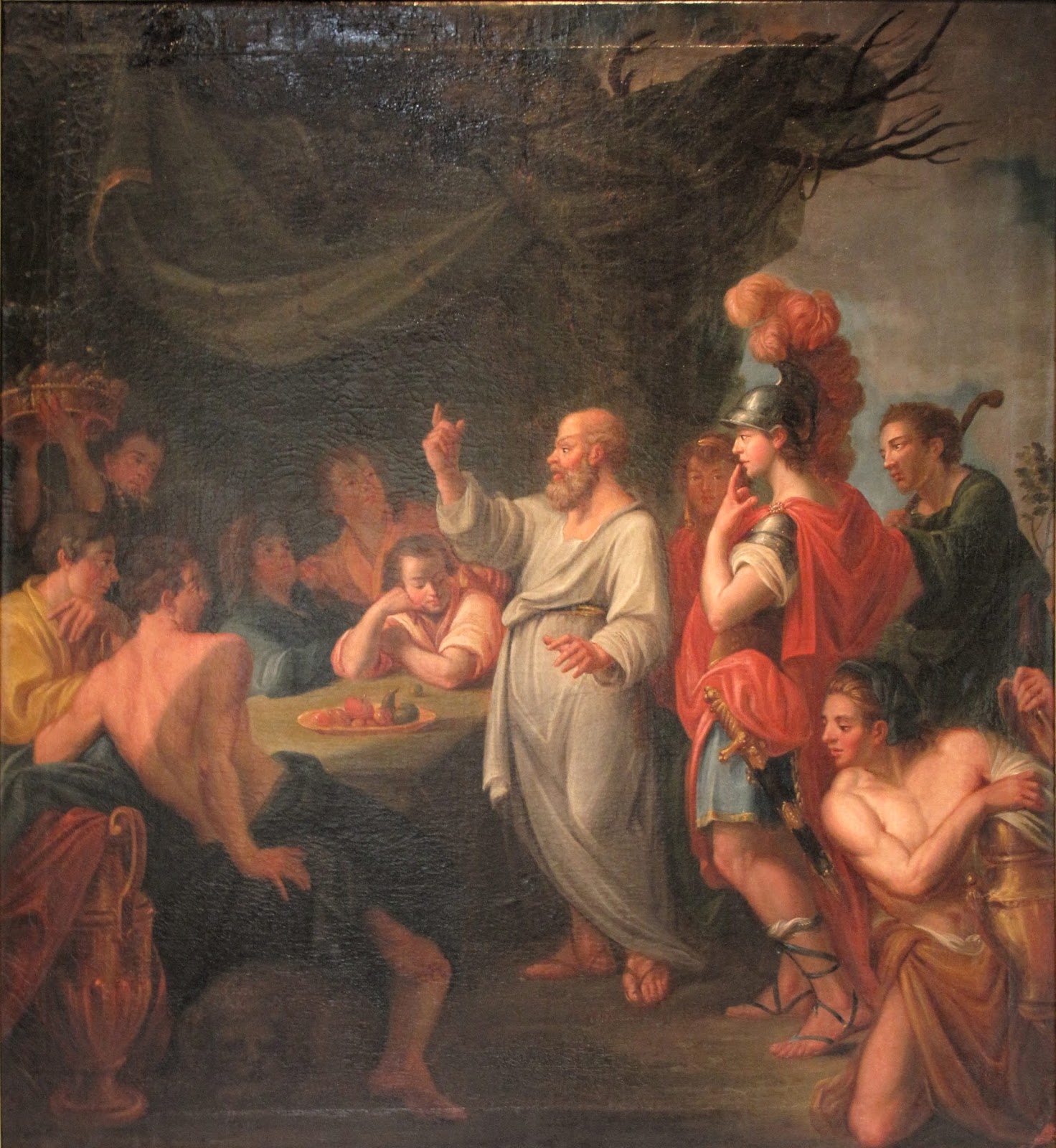
Comment Policy from Socrates

Here at Adoro Ergo Sum, I have a simple policy regarding comments and debate on the issues presented for your reading pleasure. It's been awhile since I've been able to post regularly thanks to a class I've developed and which I've been engaged in teaching over the last year on the Divine Comedy of Dante Alighieri - the greatest poem in the history of mankind - which ought to be read a couple times by every learned person.

As I hope to be able to post on a more regular basis coming up, I thought a brief reminder on the comment policy might be in order:
I am one of those people who are glad to have their own mistakes pointed out and glad to point out the mistakes of others, but who would just as soon have the first experience as the second; in fact I consider the first a greater gain, inasmuch as it is better to be relieved of very bad trouble oneself than to relieve another, and in my opinion no worse trouble can befall a man that to have a false belief about the subjects which we are now discussing. So, if you are of the same mind let us go on with the conversations but if you think that we ought to abandon it let us drop it at once and bring the argument to an end. - Socrates, in Plato's Gorgias
Here's to helping one another overcome error!

Socrates Teaching Perikles by Nicolas Guibal (1780)

Subscribe to our mailing list (no spam - EVER!)

* indicates required