Showing posts with label Mass. Show all posts

Thursday, October 20, 2016

Gloria tibi, Domine!

Christ is really present in the Most Blessed Sacrament. At Mass we are transported away from our workaday world to the very foot of the Cross, to Calvary, to witness the offering of Christ of Himself to His Father in the Spirit. What was once mere bread and wine no longer exists. It is now The Lord - Body, Blood, Soul, and Divinity, despite the remaining presence of the accidents, the appearances, of bread and wine. We all know this from second grade CCD class, but do we live it? Here are some practical ways we live this great mysterion in our family.

 At Mass

1) Do you ever wish you could have lived when Jesus walked the Earth? You do. But to meet Him you, much like those who met Jesus during His Earthly ministry, have to be willing to go where He is and that place is the Mass. Jesus Himself, the Second Person of the Most Holy Trinity, He through whom all things were made (cf. John 1:3), including you, is really, truly, physically present at the Mass, just like He was when He taught on the Mount of the Beatitudes (cf. Matt 5), raised Lazarus from the dead (cf. John 11:43), restored sight to the blind man (cf. Mark 8), or celebrated the Last Supper with His disciples (cf. Luke 22). Would you have traveled to see Him then? Then travel to see Him this Sunday. Make your encounter with Christ the central event of your week, plan everything else around that. The best way to live the reality of meeting Jesus physically in the Eucharist at each Mass is pretty simple. Go to Mass


2) Only receive the Eucharist when you are free from all mortal sin. We know our venial sins are forgiven by receiving Christ at Mass in the Sacrament, but consuming His flesh and blood in a state of mortal sin increases our sin through an act of sacrilege. St. Paul tells us, "therefore whoever eats the bread and drinks the cup of the Lord unworthily will have to answer for the body and blood of the Lord. . . . For (he) eats and drinks judgment on himself" (1 Cor. 11:27, 29). If you commit a mortal sin, go to confession - meet Christ and receive His merciful love, then approach the altar.

3) Something I personally do, although this is not required of all Catholics (unlike numbers 1 and 2 above) is to receive Our Lord on the tongue, kneeling. I do this both at the forma extraordinaria (i.e. the so-called Traditional Latin Mass) and the forma ordinaria (i.e. the post Vatican II Mass), where I happen to be the only person to receive kneeling. This is a way to remind ourselves, and others at Mass, that this is truly the King of Kings and Lord of Lords we are receiving. It humbles us to kneel before him, to remind ourselves that we are nothing compared to Our God. Receiving on the tongue also forces us to recognize the uniqueness of receiving the Lord. This isn't regular food and the way we receive it should reflect, rather than obscure, that fact. What else do you eat by having someone place the food upon your tongue while on your knees? What else do you eat by putting it into your own mouth while standing? Again, this isn't required of Catholics, you're not a bad Catholic if you don't do it, but it helps me greatly to enter into the mystery of faith.


Padre Pio receiving Our Lord

4) Silence. Be quiet and pray to the Lord before and after receiving Him. Forget about singing along to the communion hymn and just be still in God's presence. I usually recite the Anima Christi before heading up to the altar and the Sucipe by St. Ignatius Loyola afterwards. Then I sit in silence or unburden myself to the Lord. That is assuming my kids are cooperating!

5) Related to number 3 is genuflecting before the tabernacle before you enter the pew at church. This is a way of paying homage to Christ's presence among us. Note, we neither genuflect (i.e. briefly kneel on our right knees) to the front of the church, nor to the altar, but to the tabernacle - wherever it might be placed.

Outside of Mass


1) Adoration. I don't get away to adoration as much as I'd like to, but it is a great way to extend what we do at Mass and to remind ourselves of Christ's presence in the Eucharist. Kneeling before the Lord in the monstrance provides the silent contemplation of this holy mystery that allows us to be better disposed to receive the graces He wants to give us when we receive Him at Mass. Remember this is Jesus and He is sitting right there waiting for you to just be with Him. Adoration is preparation for Heaven, only then we will see fully what now we only see dimly (cf. 1 Cor 13:12). What do I do at adoration? Pray. Sit. Just be in His presence. Being there with Him is what counts.


2) Gloria tibi, Domine! This is an easy one, but it is very important. I teach my kids to pray a short prayer, typically gloria tibi, Domine whenever we pass a Catholic Church. Why? Because every Catholic Church reserves the Eucharist in the tabernacle every day (except Good Friday and Holy Saturday). When you pass a Catholic Church you are walking right past The Lord. Act like it! Doing something as small as saying a few words recognizing His presence weaves the reality of the Sacrament into the fabric of your life.

Those are just a few ways to take the dogma of transubstantiation, something that seems so abstract and philosophical, and live it. 

Sunday, August 9, 2015

5 Reasons to Attend Mass Each and Every Week

In my latest article for Catholic365, I discuss five reasons we ought to be at Mass each week. Hopefully none of you regular readers need more than one reason - Jesus is there - but in case you are trying to get friends and family back to Mass, these other reasons might help!


It’s Sunday… again. 
You know what that means? Going to church. 
For many Catholics the “Sunday obligation” is a drag, a chore to get out of the way so that they can better enjoy their day off. But is that how we ought to feel? 
St. Pope John Paul the Great didn’t think so. He said each Sunday is... 

Read the whole thing there.

Thursday, June 4, 2015

Pray the Mass Like the Saints: 5 Prayers to Get the Most Out of Sunday Mass

The Mass is the supreme event of the week. It is, as the Second Vatican Council assures us, “the source and summit of the Christian life” (Lumen Gentium, 11). Unimagined graces pour forth from this supreme act of worship, from the re-presentation of the once-for-all-sacrifice of Christ (cf. Heb 10). These graces are enough to utterly transform your life and mine, to make us “partakers of the divine nature” (2 Peter 1:4), perfect as God Himself is perfect (cf. Matt 5:48). At Mass we encounter everything necessary to become great saints. Thus, the Second Vatican Council declared,
for well-disposed members of the faithful, the liturgy… sanctifies almost every event in their lives; they are given access to the stream of divine grace which flows from the paschal mystery of the passion, death, the resurrection of Christ, the font from which all sacraments… draw their power. (Sacrosanctum Concilium ,61, emphasis added)


Yet, we often leave this font of all graces uninspired and untransformed. Why?

One primary cause is a lack of interior participation. All too often we, especially in the US, focus on exterior participation as if busyness were a sign of holiness. We can easily fall into the trap of being present at Mass “only in a ‘bodily’ manner and not ‘in… heart.’ (Lumen Gentium, 14). When we attend Mass in a mechanical way, parroting memorized responses without contemplating the meaning of the words we are annunciating, the objective graces we receive can be bound within us and bear limited or no fruit.

Some are tempted to blame bad homilies, worse music, and liturgical abuse and innovation for uninspiring Masses and there is certainly something to be said for this critique. No less an authority than Pope Benedict pointed out,
“that ‘the best catechesis on the Eucharist is the Eucharist itself, celebrated well.’” (Sacramentum Caritatis, 64, emphasis added)
However, when we come face-to-face with Christ the Just Judge at life’s end, a weak defense will it be to claim “I’m not a saint because father didn’t preach good homilies and the music director played Lord of the Dance and Gather Us In each week.” 

“I never knew you, depart from me” (Matt 7:3), may come the fearsome reply. 

As all of us will be under judgement and few of us are priests or music directors, we lay Catholics must worry less about how the Mass is being celebrated and more about how we are participating.  We must make the best of what is available to us, take charge of our own quest for holiness (cf. Lk 13:24), and delve into the riches of the Mass regardless of the external distractions we might be forced to deal with or of the interior distractions which might plague us.

One way of deepening our appreciation of the Mass is to focus on the Heavenly realities the Earthly actions are conveying. This is interior participation without which all the fussiness and motion in the world cannot bring you one step closer to God. Indeed, without true interior participation all the chant and incense in the world can’t make you holy either.

There are many ways to increase our interior participation at Mass. One way is to pray the Mass with the saints. As the Mass is designed to make us saints (cf. Sacrosanctum Concilium, 59), praying the Mass with those who have already attained sanctity is a proven method for growing closer to God, to living in harmony with “the love that moves the sun and the other stars” (Dante Alighieri, Paradiso, XXXIII: 145).


The Prayers

With this lofty goal in mind, when I feel I need to deepen and renew my subjective experience of the objectively perfect worship offered God in the Holy Mass, I turn to trusted prayers from some of the greatest saints in Church history. I hope these will inspire you as well.

1) Before Mass Begins
I will go unto the altar of God.  It is not myself and my tiny little affairs that matter here, but the great sacrifice of atonement.  I surrender myself entirely to Your divine will, O Lord.  Make my heart grow greater and wider, out of itself into the Divine Life. Amen.
St Teresa Benedicta

This short prayer perfectly sets the stage for a fruitful experience of the Holy Sacrifice of the Mass. St. Teresa, in a few short lines, places our focus squarely on the “the altar of God” (not on “we the people,” father, or anything else), forces us to dismiss as trivial the things that so occupy us during the week, and calls us to surrender our wills to His Will - the key task in becoming a saint. With this little prayer on our lips and in our minds, we are better prepared to get the most out of the sacred mysteries we are about to behold.


2) At the Consecration

At the holiest moment of the Mass, St. Thérèse of Lisieux reminds us that what we are witnessing, as mundane as it might seem to a causal viewer, is in fact the most powerful “weapon” on the face of the Earth. The ancients knew well that life was impossible without worship and that worship was impossible without sacrifice. One need only think of the pagan cults or the rites preformed at the Jerusalem Temple to see how worship demanded, from the time of Cain and Abel, a sacrificial offering. The idea that songs and readings were enough was unfathomable to pre-modern man. Most of this has long since died out, except in Catholicism. Though our Sacrifice is unbloody, the Mass is still a sacrifice offered to God. This point can sometimes be missed by modern congregations, where we have a tendency to see ourselves as the primary actors and where we tend to demand “to be fed” by our worship. The Little Flower corrects this for us right at the moment the Sacrifice to end all Sacrifices is in our midst,
O Jesus, my whole strength lies in prayer and sacrifice; these are my invincible weapons, and experience has taught me that the heart is won by them… Amen.
3) After Receiving Communion

After consuming the precious Body, Blood, Soul, and Divinity of Our Blessed Lord, St. Thomas Aquinas focuses our minds on what Communion really is. This isn’t just a “communal meal” with “inclusivity” as its highest goal. No. Here we trod, with Moses, on “holy ground (Ex 3:5).” Here we encounter God, not in the raging tempest or the quaking Earth, but in “a small still voice” (1 Kings 19:12). And, like the Wise Men who were forced to return “to their own country by another way” (Matt 2:12), we too are called to leave this meeting with Christ with a change in course. St. Thomas’ words remind us of the effects, both immediate and eternal, that Holy Communion is designed to have on those happy souls “called to the marriage supper of the Lamb” (Rev. 19:9).

I give Thee thanks, O holy Lord, Father Almighty, eternal God, Who hast vouchsafed, not for any merits of mine, but solely out of the condescension of Thy mercy, to satisfy me a sinner, Thine unworthy servant, with the precious Body and Blood of Thy Son our Lord Jesus Christ.
I pray that this holy Communion be not to me a condemnation unto punishment, but a saving plea unto forgiveness. May it be unto me the armor of faith and the shield of good will. May it be the emptying out of my vices, the extinction of all concupiscence and lust, the increase of charity and patience, of humility and obedience, and of all virtues; a strong defense against the snares of all enemies, visible and invisible; the perfect quieting of all my evil impulses, both fleshy and ghostly; a firm cleaving unto Thee, the one true God; and a pledge of a blessed destiny.
And I beesech Thee, that Thou wouldst vouchsafe to bring me, a sinner, to that ineffable banquet, where Thou, with Thy Son and the Holy Ghost, art to Thy saints true light, fullness of content, eternal joy, gladness without alloy and perfect bliss. Through the same Christ our Lord. Amen.

4) At the End of Mass

This one isn’t technically by a saint, but it is by one of my favorite popes and I pray it with my sons all the time after Mass. This prayer was universally said after every low Mass before the liturgical changes in the later 1960s. Pope Leo XIII composed this short invocation to St. Michael after witnessing a horrifying vision of Satan’s plans to destroy the Church. The evil visited upon the world following the Pope’s vision (the world wars, the depression, the Holocaust, abortion, the destruction of marriage, apostasy in what was Christendom, etc) proves the acuity of his premonition. As evil is no less a threat today than it was when Pope Leo asked the faithful to pray this, it is time, on a grassroots level, to bring this prayer back into universal use.

Saint Michael the Archangel, defend us in battle.Be our protection against the snares and wickedness of the devil, May God rebuke him we humbly pray,And do thou, O Prince of the Heavenly Host,By the Divine Power of God, Cast into Hell Satan and all the evil spiritsWho roam throughout the world seeking the ruin of souls. Amen.

5) On the Way Home
Almighty God, you have generously made known to human beings the mysteries of your life through Jesus Christ your Son in the Holy Spirit.Enlighten my mind to know these mysteries which your Church treasures and teaches.Move my heart to love them and my will to live in accord with them. Amen.
These last words, from the pen of St. Charles Borromeo, build perfectly upon the final words of the Mass, “Ite, Missa est, the Mass is ended, go in peace.” The Mass might be ended, but the effects of the Mass are meant to persist. St. Charles’ prayer reminds us to think with the mind of the Church (sentire cum ecclesia) and to live our lives in accord with those thoughts rather than in accord with the “spirit of the age.” We’ve encountered the Living God in the most intimate of manners, now we must allow the grace we’ve gained to transform our lives so that we may bring our little corner of the world under the sway of Christ the King. 


Print these prayers out, put them in your missal, purse, or pocket and get ready to pray the Mass with the saints. These holy men and women are with you at Mass. They are now forever worshipping God and yearn to aid you to eventually join them.


Do you have a favorite prayer from the saints that you pray before, during, or after Mass? Please share it in the comments below! 

Wednesday, May 13, 2015

Communion in the Hand? What Are Catholics to Think?

I recently partook in a debate on a closed "Catholic Defenders" page on Facebook surrounding the issue of Communion in the Hand and Extraordinary Ministers of Holy Communion and thought it might be instructive to share some of it here.

The post started by referencing a great little article by Father Richard Heilman entitled The Truth About Communion in the Hand While Standing. The article is worth reading in its entirety and can be debated by Catholics of good conscience on various points. Such a debate is not what interests me here, rather what I found interesting was the reaction to the article among my fellow "Catholic Defenders" (or, at least, among some of my fellow "Catholic Defenders").

St. Padre Pio Receives the LORD

What's the Body Got to Do With It?
The primary objection to Fr. Heilman's promotion of the traditional (and still universal) norm for receiving Communion in the Latin Rite (i.e. kneeling and on the tongue) was shrouded in a pseudo-gnostic "all that matters is your interior disposition" mentality. Those objecting to kneeling on these grounds basically were claiming that our bodies are so unimportant that any physical disposition would do for receiving the Lord as long as our inner "spiritual" disposition was correct. My response,
Certainly, interior disposition is important but so is bodily disposition. Let's not be Gnostics, "all that matters is my heart revering Jesus." The Lord comes in the Flesh, physically, in the Eucharist. We ought to, physically, show our respect. Yes, an interior disposition of reverence is necessary, but it is is not sufficient. In our Latin tradition, kneeling, not standing, is how we publicly show our love and respect for our Eucharistic Lord and it is still the norm for the Universal Church.
Which lead to the objection that everyone ought to assume whatever they "feel" (don't you love the subjective content that word carries?) is the proper to show their individual reverence. To which I replied,
Contra the "everyone do what they feel like in their heart" attitude, the GIRM (General Instruction of the Roman Missal - the book that governs the celebration of the Mass) envisions something a bit different, "A common posture, to be observed by all participants, is a sign of the unity of the members of the Christian community gathered for the Sacred Liturgy: it both expresses and fosters the intention and spiritual attitude of the participants."(42). I'm simply suggesting the traditional posture ought to be this called for "common posture." Although I do so with the caveat that the Church currently allows for both postures, even though the division this creates is undesirable.

What About the Infirm? 
This lead one commenter to bring up the situation of an elderly infirm woman, suffering great sickness - indeed she is dying of her illness. This woman can't kneel. She must stand. Wouldn't it be a great lack of compassion to deny such a woman the healing presence of the Lord simply because she can't assume the traditional posture of reception of Our Lord? I responded,
"Hard cases" make for bad law. Such is true when someone tries to defend abortion by appealing to the minuscule amount of abortions in situations of rape or incest, such is true with your comment above. Are there certain extreme situations where a person can't receive in the normal way? Of course. And some people are so sick they can't come to Mass at all on a given Sunday (think of someone with the flu). But that in no way makes it okay for people to just choose to receive in a less reverent manner. We are to do the best we can. For someone with knee problems that might well mean sitting to receive. But that isn't the case for 99% of American Catholics.
Pope Benedict XVI only distributed Communion on the Tongue

What About Those Who Receive Kneeling, but Without a Proper Interior Disposition?  
The prospect of someone receiving the Eucharist, kneeling and on the tongue, but without a proper interior disposition was brought up and contrasted with another person, who receives standing and in the hand, but well disposed interiorly. I replied,
Can someone receive kneeling irreverently. Of course they can, but again, that means nothing. That would be like saying rapists don't use contraception and loving married couples do, therefore contraception is okay. Exterior disposition is no more sufficient in and of itself than interior disposition is as we are neither mere animals nor pure spirits. We need both.
What About St. Cyril of Jerusalem?
It was then that poor old St. Cyril of Jerusalem was brought up. If you ever have any conversation with anyone about Communion in the hand, you'll run into the following quote (taken out of context as we will see in a moment) from this Church Father, the quote, as presented, is,
ST. CYRIL OF JERUSALEM.(Cateches. Mystagog. v.(1))
When thou goest to receive communion go not with thy wrists extended, nor with thy fingers separated, but placing thy left hand as a throne for thy right, which is to receive so great a King, and in the hollow of the palm receive the body of Christ, saying, Amen. [4]
It is important to note that this is the one and only quote from the Church Fathers that mentions anything like our modern practice of receiving Communion here in the US. There are many other quotes, from various Church Fathers, that attest to the early Church receiving the Lord in the traditional manner. It is also important to note that St. Cyril is an Eastern Church Father, thus he is describing not what was then practiced in the Latin Rite, but what was then practiced in the Eastern Church. Thus, Cyril's description has no bearing on Latin tradition. Finally, we must keep in mind that some of the works attributed to St. Cyril are thought to be fallacious. This passage comes from one of these "doubted" works. However, and most damaging of all to those who bring up this passage, is the context (remember, a text without context is a pretext for a prooftext). Let's see the full quote from St. Cyril (if it is from St. Cyril) - emphasis added,
"Approaching therefore, do not come forward with the palms of the hands outstretched nor with the fingers apart, but making the left [hand] a throne for the right since this hand is about to receive the King. Making the palm hollow, receive the Body of Christ, adding 'Amen'. Then, carefully sanctifying the eyes by touching them with the holy Body, partake of it, ensuring that you do not mislay any of it. For if you mislay any, you would clearly suffer a loss, as it were, from one of your own limbs. Tell me, if anyone gave you gold-dust, would you not take hold of it with every possible care, ensuring that you do not mislay any of it or sustain any loss? So will you not be much more cautious to ensure that not a crumb falls away from that which is more precious than gold or precious stones?
"Then, after you have partaken of the Body of Christ, come forward only for the cup of the Blood. Do not stretch out your hands but bow low as if making an act of obeisance and a profound act of veneration. Say 'Amen'. and sanctify yourself by partaking of Christ's Blood also. While the moisture is still on your lips, touch them with your hands and sanctify your eyes, your forehead, and all your other sensory organs. Finally, wait for the prayer and give thanks to God, who has deemed you worthy of such mysteries."
Anyone who uses the St. Cyril to support Communion in the hand, but doesn't also argue for a return to rubbing Christ's Most Precious Blood all over our sensory organs is merely taking a soundbite from the saint to support a method of Communion entirely foreign to him. And, honestly, who thinks what St. Cyril says ought to be instituted immediately in all places where Christ is received in the hand? For what ever the merits of such a decision might be, we can at least admit that even Cyril doesn't describe the modern method of Communion which mirrors the way we eat everything else. Cyril's method maintains the uniqueness of Communion, albeit in a rather odd way.

Does Communion in the hand lend itself to abuse more easily than on the tongue?

Hasn't Rome Spoken on This? 
Having thus failed to dispute anything Fr. Heilman presented or to make a case that Communion in the hand ought to be the most common method of reception of the Most Holy Body of Christ, the supporters of Communion in the hand turned lastly to announcing that the Church has spoken (Roma locuta est) and that the case is, thereby, closed. This is partially true and partially not. First, we must admit that the Church has, in fact, authorized both ways of receiving Communion for Catholics here in the United States. Thus, each Catholic is free to choose for himself and should not be harassed or looked down upon for choosing one method over the other. This means both that Catholics ought not be shamed for receiving standing and, what is much more likely, shouldn't be castigated or even refused Communion for assuming the traditional posture. That being said, the Church has not, by issuing an indult, set up a "separate but equal" choice between the two methods of receiving. One method can be, and in this case is, objectively better than the other. That doesn't mean every Catholic who receive in the traditional posture is holier or better than every Catholic who receives in the novel modern manner. Very holy Catholics can be found among people on both sides (as can some people that are not holy at all). The question isn't whether you or I are better, but whether the mode of reception is. That being said, the Pontifical Commission Ecclesia Dei, 1 precisely in response to a question from bishops on whether Catholics must think optional changes in the Mass (e.g. Communion in the hand, extraordinary minister of Holy Communion, altar girls, etc) are objectively good. The answer was a clear "no." All Catholics must admit that the Church has the jurisdictional authority to make such options available. All Catholics must admit that such options being used do not make the Mass invalid, but there is no obligation on Catholics to think such options are good (or are bad). Catholics are free to agree or disagree with each other on this point and remain good Catholics.

This last point is probably the most important of all. Catholics, like myself (and in fact almost everyone at the ordinary form Mass I attend), who choose to honor Christ by using the ancient and venerable posture of kneeling and receiving on the tongue are not to think less of those Catholics who decide to receive standing (as I did for quite some time myself). That would be to fall into the worse excesses of Pharisaism and I can only imagine what Pope Francis would have to say on that score. Likewise, Catholics who opt for the novel modern method are not to look at those Catholics who kneel for Communion as "pre-Vatican 2" or "anti-Pope Francis" or "Medieval." It is fine to "evangelize" for the traditional method, but only when done in a way that respects the freedom the Church has chosen to give in this matter and only when done with extreme charity. The saying, often misattributed to St. Augustine, In necessariis unitas, in dubiis libertas, in omnibus caritas (in necessary things unity, in uncertain things liberty, in all things charity) ought to rule the day.
_____________________
1. Father Z does a great job of breaking this down HERE

Thursday, April 2, 2015

Was the Last Supper Celebrated Versus Populum?

Q. Today is Holy Thursday, the day we celebrate the Last Supper. This got me thinking. If the Mass is, ultimately, an extension of the Last Supper, why would the priest have ever faced away from the people? A meal is always shared by people gathering together around a table. Isn't this a great reason to keep the priest facing the people?

A. First, let me point you to a post I wrote giving a variety of reasons why Mass ought to be celebrated with father and the people facing together towards the Lord that might address some of your concerns. But, to speak directly to the Last Supper issue, I think I'll let Pope Benedict answer this directly:
The idea that a celebration facing the people must have been a primitive one, and that especially of the last supper, has no other foundation than a mistaken view of what a meal could be in antiquity, Christian or not. In no meal of the early Christian era, did the president of the banqueting assembly ever face the other participants. They were all sitting, or reclining, on the convex side of a C-shaped table, or of a table having approximately the shape of a horse shoe. The other side was always left empty for the service. Nowhere in Christian antiquity, could have arisen the idea of having to 'face the people' to preside at a meal. The communal character of a meal was emphasized just by the opposite direction: the fact that all participants were on the same side of the table. (Louis Bouyer as quoted in The Spirit of the Liturgy by Pope Benedict XVI)
Tintoretto, Last Supper
The Last Supper by Tintoretto (Titian)

Indeed, Pope Benedict goes on to remind us that a meal isn't the essence of the Mass.
In any case, there is a further point that we must add to this discussion of the '"shape" of meals: the Eucharist that Christians celebrate really cannot adequately be described by the term "meal". True, the Lord established the new reality of Christian worship within the framework of a Jewish (Passover) meal, but it was precisely this new reality, not the meal as such, that he commanded us to repeat. Very soon the new reality was separated from its ancient context and found its proper and suitable form, a form already predetermined by the fact that the Eucharist refers back to the Cross and thus to the transformation of the Temple sacrifice into worship of God that is in harmony with logos.... This new and all-encompassing form of worship could not be derived simply from the meal but had to be defined through the interconnection of Temple and synagogue, Word and sacrament, cosmos and history. (The Spirit of the Liturgy)
Thus we see that, for Catholics, worship (i.e. the Mass) is much more than "table fellowship." It is the offering of the once for all sacrifice to the Father in the Spirit (the fulfillment of the Temple) of the Word made flesh (the fulfillment of the synagogue).

Last Supper Titian (detail)
detail

Tuesday, December 30, 2014

Should "the Sign of Peace" be Moved to the End of Mass?

Yesterday, Crisis Magazine published a thought provoking article on the current placement of the "Sign of Peace" in the forma ordinaria of the Holy Sacrifice of the Mass. As our liturgical worship determines our beliefs (lex orandi, lex credendi), I thought it would be worth drawing attention of my readers to this important question once again.

In the Crisis piece, Gerald T. Mundy lays out why exactly the current placement is more than a bit problematic (enough so that Pope Benedict called on the Congregation for Divine Worship to look into moving or eliminating the Sign of Peace)
Rather than reminding the faithful that they are sharing in a solemn sacrifice and preparing to participate communally in worship (lex orandi), and in the Supper of the Lord, receiving His very body and blood as did the apostles on the night that they were told He was to become the Passover Paschal Lamb, the gesture of peace in its current place obliterates the reverence of the moment.
And, worse yet, it blurs the real distinction between what happens in a Catholic Mass and at a Protestant Sunday gathering,
the gesture of peace in its current place maims the Catholic teaching of the sacrificial purpose of the Mass. Evangelical Protestants and so-called charismatic Catholics similarly view worship as celebratory fun full of pomp, whistles, vocal affirmation, clapping, and music that mirrors that which is played at dance parties. The Catholic Mass, however, is not a celebration, nor it is a weekend party filled with bread, wine, and good company. Catholics gather to venerate the Eucharistic sacrifice upon the altar.
 And, if you haven't been sold on the why the sign of peace ought to be moved yet, Mundy ends his piece thus,
For at the Last Supper, when Jesus told his followers most dear that he was to die the next day, his apostles upon hearing this did not smile, hug, shake hands and break into song at the prospect of their divine rabbi’s forthcoming bloody and inhumane sacrifice. Remember, the Lord’s hands with which he raised the bread and chalice in the Upper Room would be nailed heinously to a cross, his digestive tract pierced with a spear to ensure bodily death. He looked up to heaven that evening and asked that they eat and drink in his memory. One would think that such a Lord would deserve rightful due, and that the gestures would be saved for either the conclusion of, or following, the Holy Sacrifice of the Mass. (read the whole thing there it is worth your time)
The vision of acting as most Catholics do during the sign of peace at the foot of the Cross or in the Upper Room ought to be enough to convince all but the most determined liturgical deconstructionist of the need for once more rethinking the placement of this gesture.


Where ought it be moved to? Mundy suggests the end of the Mass would be better time, perhaps right before or immediately after the Ite, missa est. Such a placement would eliminate the distractions currently caused, but would run afoul of the liturgical theology that suggests the sign of peace fulfills Jesus' commandment in Matthew 5,
If therefore thou offer thy gift at the altar, and there thou remember that thy brother hath any thing against thee; Leave there thy offering before the altar, and go first to be reconciled to thy brother: and then coming thou shalt offer thy gift. (v. 23-24)
which will surely be one of the counter arguments against moving the sign of peace to the end of the Mass. Perhaps, then, a better placement for the sign would be at the beginning of the Mass, maybe immediately following the Confiteor (which might then be brought back to each and every Mass). It is at this moment that our attention is turned toward our fellow worshippers both in Heaven and on Earth. It is then that we seek to be "reconciled to (our) brother" so as to worship with a clean conscious. Perhaps, then would be a good time to symbolically offer the forgiveness to our neighbors that they have just asked us for by offering them a sign of peace. 

Either way the current placement of the sign of peace does seem to be a distraction from the principal action of the Mass, the re-presentation of Christ's once for all sacrifice on Calvary. Of course, as the Fathers of the Second Vatican Council declared,
Regulation of the sacred liturgy depends solely on the authority of the Church... no other person even if he be a priest may add, remove, or change anything in the liturgy on his own authority. (Sacrosanctum Concilium, 22)
So we'll just have to wait for the Congregation to take another look at the matter.

Read the whole article there: The Liturgical 'Sign of Peace': Move or Remove?

Friday, October 17, 2014

Ebola Outbreak and Receiving the Eucharist, Should Disease Change Liturgical Practice?

Over at RNS we read the following reaction to the Ebola outbreak,
The Blood of Christ will not be offered during Mass. The Host will be placed in the hands, not on the tongue. And the faithful should not hold hands while reciting the “Our Father.”...
Among other precautions issued by the Diocese of Fort Worth:
  • Share the “Sign of Peace” without touching or kissing, perhaps with a smile, or “meaningful eye contact” or “a bow of the head.”
  • Priests should use an alcohol-based solution on their hands before and after distributing Holy Communion.
  • Priests should not distribute Holy Communion if they feel ill, and should discourage parishioners who feel sick from coming to church. 
Read the whole article there. A couple questions sprung to my mind...


1. Why Not Suspend the Use of All EMHC's ("Eucharistic Ministers")?
Honestly, I'm scratching my head wondering why allowing the priest (and only the priest) - who is washing his hands with alcohol before Communion - isn't among the directives. Extraordinary ministers of Holy Communion are called "extraordinary" for a reason (and it ain't 'cause they do such a great job) - because they are only to be used in special (extraordinary) circumstances. With an ebola outbreak threatening, wouldn't it make sense to limit the number of hands touching the Host all together?

women ministers of communion catholic
Have they all washed their hands with an alcohol-based solution?


2. Why Not Require (rather than forbid) Communion on the Tongue?
Speaking of limiting the number of hands touching the Host, why not forbid, rather than require, Communion in the Hand? Our hands tend to be among the dirtiest parts of our bodies. Coming into Mass we've probably touched our steering wheel, car door, Church door, other parishioners' hands, the pew, the missal, the kneeler, etc. Let's just say, even assuming we've washed our hands to go to Mass, our hands aren't exactly clean by the time communion comes around and we aren't all washing our hands in an "alcohol-based solution" right before Communion either. The priest's hands are freshly washed and will be the cleanest in the building, why not allow him (and only him) to touch the Host, allowing  each communicant to come forward, kneel reverently, and receive directly on the (clean) tongue from the (clean) hands of father? And before anyone suggests father's hands might not be so clean after he touches the first communicants tongue, allow me to point out that he doesn't touch any of the communicants tongues. He holds one edge of the Host and lays the unheld part onto the tongue of the believer. I receive on the tongue, kneeling, every week and have never had father's fingers touch my tongue.

3. What Would Our Catholic Ancestors Say?
You know the one's that survived the Plague (that killed so many people, 1 in 3 of everyone in Europe, that it has forever been immortalized simply as "the Black Death"), influenza epidemics, measles, etc without the medicines and cures we have today. Catch the Plague in the fourteenth century and your friendly doctor would treat you by nailing you and your family into your home. Did they stray into receiving Communion in the Hand? Not so much.


4. Do We Have to Receive Communion?
No. We have to go to Mass, but we don't have to receive Communion. If their is an epidemic, maybe the most prudent thing of all to do is to have the priest alone receive Communion until the danger passes.


Wednesday, September 24, 2014

Things Vatican Two Actually Said...

Looking at the picture of the Fathers of Vatican Two that I posted earlier today and had to share this...


Friday, September 12, 2014

3 Great Reminders of What Really Happens at Mass

It's the end of the week. The weekend is here. For Catholics, that means the Lord's Day, which is properly celebrated by avoiding unnecessary work and by going to Holy Mass. How often, though, can we "sleep walk" through what Vatican 2 called "the source and summit of the Christian life?" (Lumen Gentium, 11). We get so stuck in this mundane world of ours that we miss what is really happening at Mass (of course the wreckoation of many of our churches and the overemphasis on the "horizontal" dimension of the liturgy only exasperates this problem). Well, today, I thought we'd take a moment and look at what is really happening at Mass on Sunday. Note, this will be happening where you, dear reader, will be worshiping this Sunday (assuming it is a Catholic parish). This is the ground you will be troding. So when you see this (if you are lucky)


or even this


know that you are really present at this moment in time


where this is happening 


and in this company


If that doesn't get you excited, if that doesn't make you instantly understand what Vatican II was talking about, you might need to check your pulse.

Friday, August 8, 2014

Cause Enough to End Communion in the Hand Immediately?

I'm sure most of my readers have heard about the Satanist group that claims to have gotten ahold of a stolen Consecrated Host for their upcoming "Black Mass" in OKC. Apparently the host was stolen from a Catholic Church by a "friend" of Adam Daniels, the organizer of the Black Mass. This, of course, is the most grievous of all possible blasphemes, the ugliest of all possible desecrations, indeed nothing could be more noxious, more evil, or more offensive than the desecration of the Most Holy Eucharist. The Code of Canon Law reminds all Catholics of the importance of the Eucharist in the life of the Church:
Can.  897 The most August sacrament is the Most Holy Eucharist in which Christ the Lord himself is contained, offered, and received and by which the Church continually lives and grows. The eucharistic sacrifice, the memorial of the death and resurrection of the Lord, in which the sacrifice of the cross isperpetuated through the ages is the summit and source of all worship and Christian life, which signifies and effects the unity of the People of God and brings about the building up of the body of Christ. Indeed, the other sacraments and all the ecclesiastical works of the apostolate are closely connected with the Most Holy Eucharist and ordered to it. 
Can.  898 The Christian faithful are to hold the Most Holy Eucharist in highest honor, taking an active part in the celebration of the most august sacrifice, receiving this sacrament most devoutly and frequently, and worshiping it with the highest adoration. In explaining the doctrine about this sacrament, pastors of souls are to teach the faithful diligently about this obligation.

Jesus Christ


The Archbishop of Oklahoma City, His Excellency Paul Coakley, has compared this act of sacrilege with acts against other religions which would never be allowed on public property:
“It is hard to imagine the Civic Center turning a blind eye and allowing a group to use its facilities to burn a copy of the Koran, or to conduct an overtly anti-Semitic performance”
Hard indeed. Unfortunately, anti-Catholicism is alive and well in this country (as it has always been), so this infamous act goes on while acts against other religions are opposed as hate speech. Apparently, hate speech against the most sacred mysteries of the Catholic faith (with her 78 million US members, the largest Church in the US) is a-okay. Unfortunate, but unsurprising.

While we can't take much direct action to stop the proposed Black Mass from happening. This great evil doesn't have to happen again. The "most August sacrament" can be better protected, indeed must be better protected. One such way is the immediate suspension of Communion in the hand. How easy is it for a Satanist to slip into any Catholic Church anywhere in these United States, casually walk up the aisle when the Host is being distributed, stretch out his/her hand and simply walk back to the pew without consuming the Host? How many Extraordinary Ministers of Holy Communion (many of whom are elderly women) are even prepared for this possibility? Who is even watching enough to notice whether or not the Sacrament is being carried off? And if someone does notice, what is anyone prepared to do about it that will actually stop a determined Satanist?

Communion in the Hand
Does this make it too easy to lift a Host?

Church law is pretty clear on the difference between Communion on the tongue, which we all have a right to, and Communion in the hand, which is only to be allowed where there is no "risk of profanation":

Although each of the faithful always has the right to receive Holy Communion on the tongue, at his choice, if any communicant should wish to receive the Sacrament in the hand, in areas where the Bishops’ Conference with the recognitio of the Apostolic See has given permission, the sacred host is to be administered to him or her. However, special care should be taken to ensure that the host is consumed by the communicant in the presence of the minister, so that no one goes away carrying the Eucharistic species in his hand. If there is a risk of profanation, then Holy Communion should not be given in the hand to the faithful. (Redemptionis Sacramentum 92)

Clearly, the risk of profanation in the United States is much higher than anyone thought. Such a risk demands an immediate rethinking of the propriety of continuing to administer Communion in the hand across the US. Perhaps in special cases, where the priest knows the recipient, and where the recipient has a particular need to receive in the hand such reception could be accommodated, but to continue to distribute the Host in the hand of all and sundry has created an environment where the "risk of profanation" has blossomed into a full on Satanic Mass complete with Consecrated Host.

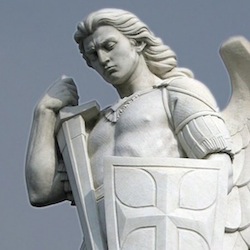
Of course, the United States Bishops are in a better position than you or I to determine if such a measure needs to be undertaken or not. It is their sacred charge to handle such matters and, with the guidance of the Holy Spirit, they are sure to take whatever steps they deem necessary to minimize possible future desecration of the Body, Blood, Soul, and Divinity of God Himself. In the meanwhile, let's all join together in praying to St. Michael, defender of the Church and destroyer of Satan:

St. Michael the Archangel, defend us in battle
Be our protection against the wickedness and snares of the devil,
May God rebuke him we humbly pray.
And do thou, O Prince of the Heavenly Host, by the Divine Power of God,
Cast into hell Satan and all the evil spirits roaming about the world
Seeking the ruin of souls.
Amen.


St. Michael the Archangel
St. Michael defend us!


What do you think? Should Communion in the hand be restricted to prevent future desecrations or is such an action too much too soon for the current situation? Would requiring Communion on the tongue be a prudent safeguard or an overreaction to one horrible incident?

Thursday, August 7, 2014

How to Explain the Mass to a Protestant.

A commenter on my Google+ Page (which you can follow HERE), made the following very interesting point on my recent post "DO CATHOLICS WORSHIP STATUES?"


Another is the idea of the worship of Mary and the saints. I am inviting a protestant friend to Mass for the Assumption of the Blessed Virgin Mary. Hopefully he won't think it as Marian worship but instead see it as a way of honouring her.
First of all, let me commend the commenter for already planning on attending Mass next Friday for the Holy Day of Obligation (not suggestion) on August 15 - the Feast of the Assumption of the Blessed Virgin Mary. Have you already made plans to? Remember, deliberately blowing off a holy day of obligation (including ALL Sundays) is, under normal circumstances, a mortal sin. Let me also commend him for reaching out to his Protestant friend on such an important feast. What a great idea to offer to bring a non-Catholic (i.e. a potential-Catholic!) with you for Mass next Friday! They can still attend their regular service on Sunday, which really opens up the possibility of them agreeing to come. And what could be more pleasing to Our Lady than to have our separated brethren at Mass in her honor? We should all invite someone, either a lapsed or non-Catholic, to come with us to this great feast day as a way of showing honor to Our Lady!

For those that do end up taking a potential-Catholic with you, you'll probably have the same concern the commenter had, what if they see the Mass and think we are worshipping Mary? I'd recommend a preemptive strike, something our former Commander-in-Cheif would be proud of. Instead of waiting for the objection to come, which may, after all, end up unvoiced, give an explanation before Mass.

I'd point out to the potential-Catholic how the Mass is offered to the Father (not to Mary) through the Son (not Mary) in the Spirit (not Mary). Father, Son, Spirit - to God, through God, in God. Offering the Mass to Mary is the sin of idolatry and is absolutely forbidden by the Church. The Mass can only be offered to the Father. Period. We honor, maybe a better word for the non-Catholic is remember, different saints, maybe a better word would be different great Christians, at different Masses, because we are all a part of the same family and are all in relation with each other. (see DEAD PEOPLE CAN'T PRAY FOR YOU! A CATHOLIC RESPONSE). Remembering someone, honoring them, even with a religious service, isn't "worshipping them" as Protestants know from honoring their dead relatives at their funeral services. Why, you might point out, offering a Mass today for Mary is no different than the funeral service you offered for your grandma when she passed!

The underlying problem is that Protestants lost the true sense of worship with Luther and Calvin's revolution five centuries ago. All worship, even in pagan religions and certainly within all Christian communities (Catholic and Orthodox) before the Reformation and even in Jewish worship before Christ stretching all the way back to Cain and Abel and presumably Adam and Eve, involved offering a sacrifice on an altar. That is the essence of all true worship. Jesus Christ made the definitive sacrificial offering when He offered Himself on the Cross for our sins, and it is precisely this sacrifice (the Sacrifice of Golgotha) that Jesus offers continuously to the Father in heaven (cf. the Book of Hebrews and Revelation). It is this once for all sacrifice (that is eternally offered) that the Mass manifests on Earth through the priest. Catholic worship, like all true worship,  involves offering a sacrifice on an altar - this sacrifice is only ever offered to the Father.


Caravaggio
Worship has always meant sacrifice

Protestants, having lost all sense of worship as sacrifice, have conflated prayer and song (which accompany worship, but are not themselves worship) with worship. They no longer offer God any sacrifice, having cut themselves off from the priesthood which manifests the Sacrifice of Christ in their midst to be offered eternally to the Father. Instead, their services, which would not have been considered worship by anyone anywhere before Luther and Calvin, feature Bible readings, songs, prayers, and sermons. Thus, when they see us singing about or praying to or having a sermon on Mary they think we are worshipping her! This, of course, is absurd. If singing about and talking (praying) to someone is worship, most Protestants worship their girlfriends!

Explaining the meaning of the Mass and how it is always and everywhere offered as a Sacrifice to the Father might help your Protestant friend to see how we don't worship the saints in or out of Mass. Just make sure they also understand that:
1. The Mass isn't a separate sacrifice from Calvary2. The Mass isn't a "re-crucifixion" of Jesus, just a re-presentation of the once-for-all Sacrifice of Calvary to the Father. Jesus isn't killed again, He is just offered again so that we, living 20 centuries after His Death, might join in the offering.


Catholic Priest at Mass
What we see happening at Mass


Priest offering the Host to God
What is really happening at Mass


To Learn More About the Mass, I Recommend:

THE MASS: THE GLORY, THE MYSTERY, THE TRADITION, by Cardinal Wuerl, get your copy on Amazon HERE.
The Mass by Mike Aquilina