"STRIVE to enter by the Narrow Gate" (Lk. 13:24) “the gate not used by souls whose twisted love attempts to make the crooked way seem straight.” (Purgatorio, 10.1-3)
Showing posts with label books & book reviews. Show all posts
Showing posts with label books & book reviews. Show all posts
I thought I might share with you what I've managed to read (or re-read as the case may be) this year. If any of the titles interest you, I've provided a link to Amazon where you can purchase the book. If you've read any great books this year, make sure to let us know in the comments so our readers (and myself!) can check those out too.
If you have any questions about any of these books drop me a line in the combox and I'll try to answer all of them.
I'll be taking a break from blogging in January. See you all in February.
In Dicken's A Christmas Carolwe meet the embodiment of Avarice, Ebenezer Scrooge, a man who loved gold more than God. His opinion of Christmas is well known to us all,
Merry Christmas! Out upon a merry Christmas! What's Christmas time to you but a time for paying bills without money; a time for finding yourself a year older, but not an hour richer; a time for balancing your books and having every item in 'em through a round dozen of months presented dead against you? If I could work my will... every idiot who goes about with 'Merry Christmas' upon his lips, should be boiled with his own pudding, and buried with a stake of holly through his hear. He should! (pp. 5-6)
Scrooge's love for money has replaced not only his love of Christmas, but love of anything else. This love of money isn't just greed, it is a false religion.
Dante dramatically presents this reality to us when he stands before the damned Pope Nicholas III (Giovanni Gaetano Orsini),
Fatto v'avete dio d'oro e d'argento;e che altro è da voi a l'idolatre,se non ch'elli uno, e voi ne orate cento?
You have wrought yourselves a god of gold and silver.
How then do you differ from those who worship idols
except they worship one and you a hundred? (Inferno19.112-114)
St. Thomas Aquinas addresses the "spirit of Scrooge" in the Summa
man seeks, according to a certain measure, to have external riches, in so far as they are necessary for him to live in keeping with his condition of life. Wherefore it will be a sin for him to exceed this measure, by wishing to acquire or keep them immoderately. This is what is meant by covetousness, which is defined as "immoderate love of possessing." It is therefore evident that covetousness is a sin. (II-II. Q. 118, A. 1)
Or, in the more recent words of Pope Benedict XVI
Material possessions, in themselves, are good. We would not survive for long without money, clothing, and shelter. We must eat in order to stay alive. Yet if we are greedy, if we refuse to share what we have with the hungry and the poor, then we make our possessions into a false god. How many voices in our materialist society tell us that happiness is to be found by acquiring as many possessions and luxuries as we can! But this is to make possessions into a false god. (Address to Disadvantaged Youth, in Sydney, Australia.)
How tempting it is this time of year, especially for those who ignore Advent, focusing solely on the "shopping season" of the secular Christmastide - Black Friday through December 24th, to focus overly much on possessions. Indeed, admirably, much of this is the opposite of what Scrooge lived for. He wanted only to take, to increase, while ignoring those others about him. We rather look to purchase things for others, for those we love and cherish. However, this Advent I would recommend to you to take it one step further - give to someone in need. Not just through an organization, great and commendable as that may be, but directly, personally. How can you find such people? Contact your parish, they'll point you in the right direction. For Scrooge himself began to recognize this. While haunted by the Ghost of Christmas Past, upon seeing his younger self, he remembers a small boy who had earlier began singing God bless you, merry gentlemen! May nothing you dismay! at his keyhole. Scrooge's reaction?
Scrooge seized the ruler with such energy of action, that the singer fled in terror, leaving the keyhole to the fog and even more congenial frost. (p. 9)
His later reaction to his behavior?
'I wish,' Scrooge muttered, putting his hand in his pocket, and looking about him, after drying his eyes with his cuff: 'but it's too late now.'
'What is the matter?' asked the Spirit.
'Nothing,' said Scrooge. 'Nothing. There was a boy singing a Christmas Carol at my door last night. I should have liked to have given him something: that's all.' (p. 26)
We might not have the poor singing carols at our doors, but they might be a lot closer than you think.
If that isn't enough to motivate you, remember how Jesus, "the reason for the season," identifies Himself with the poor,
Come, you who are blessed by my Father, inherit the kingdom prepared for you... For I was hungry and you gave me food, I was thirsty and you gave me drink, I was a stranger and you welcomed me, I was naked and you clothed me, I was sick and you visited me, I was in prison and you came to me.... Truly, I say to you, as you did it to one of the least of these my brothers, you did it to me. (Matt. 25:34-40, ESV)
Have a holy Advent.
Come, Lord Jesus! The grace of the Lord Jesus be with all. Amen.(Rev. 22:20-21, ESV)
Dante lived this multifaceted life while producing the greatest poetry in world literature. He definitely wasn't an Essentialist.
His life has been the topic of countless biographies, essays, talks, and lectures over the last seven centuries. The latest, Marco Santagata's Dante: The Story of His Life, translated by Richard Dixon, continues in this tradition.
Scholarship
Santagata brings a wealth of erudition and study to the task of writing an interesting biography of Dante. Indeed, he manages to break into new ground, which is always impressive when writing about a man written about as frequently and for so long as Dante. His mastery and clear elucidation of the complex political history engulfing Dante's Florence and Italy is the highlight of the book and alone makes it worth the money.
Not only does he vividly describe the troubled times our poet navigated, but he contemplates into under-explored possibilities. Nothing less would be expected of Santagata, professor of Italian Literature at the University of Pisa.
Some of these theories are more compelling than others. Let us, briefly, examine a few.
Corso Donati
One interesting possibility explored by Santagata is an alleged attempt by Dante to return to Florence, something dear to the poet's heart, through the means of Corso Donati.
Anyone who has spent anytime studying Dante knows that Corso, condemned to Hell according to the prediction of his brother Forese in Purgatoriowas one of Dante's prime enemies.
I see him... dragged behind a beast toward the valley where there is no absolution. The beast goes faster with each step, and faster, until it hurls him to the ground and leaves his body horribly disfigured.(24.82-87)
It was Corso Donati, leader of the Black Guelfs, whose ascendancy would prove the proximate cause of Dante's lifelong exile. It would seem odd, then, that Dante would pin his hopes for return on the very man who led the party that exiled and sentence him to death. Santagata sees Dante's marriage to a distant relative of Corso's, Gemma Donati, as a possible bridge between the two.
In my view, Dante and his supporters would first have played the family card. Gemma was a Donati, a third cousin of Corso, and her readmission to the city would have done no harm to the family prestige: indeed, if anything, it would have increased it. By allowing considerations of kinship to prevail, Corso would have shown himself to be the true man of strength in Florence. (p. 191)
This might be too tenuous and hard to swallow. Corso would have "shown himself to be the true man of strength in Florence" without calling back a man he helped exile. In fact, that just as likely would have shown Corso to be a man of great weakness. It could even have contaminated him to association. The time in which Santagata thinks Dante could have used Corso's help was when Corso was losing influence in the Black Party to Rosso della Tosa. While highly unlikely this is an interesting possibility to contemplate.
Epilepsy
Another interesting theory explored in the book is the possibility of Dante having been an epileptic. Santagata admits his debt here to Cesare Lombroso and his school of psychiatry's diagnosis of Dante, a disgnosis Santagata readily admits "has never been accepted by Dante scholars." (p. 31)
Despite this, reading Dante's poems has helped Santagata 'rediscover' Dante's illness. He points to the poem E' m'incresce di me sì duramente as evidence. In the poem, Dante relates an experience from the first few months of his life.
"so suddenly... I fell to the ground" as if struck by lightning." (p. 30)
Dante's Amor, da che convien pur ch'io mi doglia is another exhibit as Dante tells us the mere sight of his lady caused him to fall "lifeless" to the ground.
This is certainly a literalist interpretation of these poems, which sounds a bit odd coming from a man who questions whether Beatrice really inspired Dante's writings. Admittedly, Santagata avoids the common error of reading Beatrice as only an allegory of "Theology" to the point where her name could be dropped for the subject, but his suspicion here could call into question his reading into these poems a disease. If Dante attributed inspiration to Beatrice as a poetic device, why ought he not to have used fainting poetically as well?
Nonetheless, Santagata is right on the money when he says this is
an hypothesis to explore with caution, but nevertheless (is) preferable to the idea suggested by one scholar that (Dante) used stimulants or narcotics. (p. 33)
I couldn't agree more.
Dante's Sense of Self
Santagata contends that Dante had a very unique sense of himself and his life.
The most remarkable aspect of Dante's personality is, in fact, his feeling of being different and predestined. In whatever he saw, did or said... he glimpsed some sign of destiny, the shadow of an unavoidable fate, the mark of a higher will.... How can we avoid asking, then, what kind of self-image such an egocentric man, so sure of his exceptional nature, must have possessed in daily life? (p. 4)
Whether this is an accurate description of the inner workings of Dante's personality is, as all such "remote psychoanalysis" must be, highly questionable. No psychologist worth his salt would seek to describe the inner psyche of a man who never laid upon his couch, that, however, doesn't stop (some) historians. Santagata has fallen into this trap. This is particularly jarring as he readily admits,
His contemporaries offer little help to anyone wishing to reconstruct the true Dante. Almost none of those who knew him wrote about him; only a few of the next generation had anything reliable to say about him. (p. 5)
Apparently, eight hundred years after the poet's death, Sanatagata can, based off what he sees as less than credible historical accounts, have something "reliable to say about him."
Was Dante prideful? Without a doubt. This is a man who, based off the Vita Nuova and a few canti of the Comedy, claimed poetic equality with the greatest poets in history: Virgil, Homer, Ovid, Horace, and Lucan when he tells us "I became a sixth amidst such wisdom" (Inferno 4.102) and who feels the heavy weights the penitents on the terrace of pride must bear already.
Can we extrapolate out of his work all Santagata does? That is a bit more questionable, but worth reading his theory in full to decide for yourself.
Dante: The Story of His (Political) Life, Revenge and Patronage
This might well have been a more apropos title to this biography. Santagata tells the story of Dante almost exclusively through a political lens leaving unmentioned or marginalized Dante's relationship with the Church as an institution, with Christian belief, with philosophy as expounded by the Scholastics, with his poetic rivals and predecessors, and with his intellectual development from a servant of "the god of Love" to the supreme poet of the Christian God.
This narrow focus spills over into his interpretation of the Commedia, which is viewed as if it was only a political work. Each event examined by Santagata is seen as either an attempt to gain favor with a potential or current patron or as an act of revenge on those who rebuffed the poet in life.
He calls the first canticle of the Comedy "The Guelf Inferno" (p. 219)contending Inferno is entirely Guelf without a hint of pro-Imperial sentiments. This, according to Santagata, is because Inferno was largely written to assert Dante's loyalty to the Guelf cause as a means to return to Guelf Florence.
He fails, however, to convincingly explain the condemnation of the leading Guelfs in the cantica. Tegghiaio Aldobrandini, Jacopo Rusticucci, Calvacante Calvacanti, the great Guido Guerra and Brunetto Latini are all inexplicably (if we accept Santagata's thesis) met in the "Guelf Inferno". Nor does he address why, if the canticle is stressing Dante's loyalty to the Church Party, we meet Pope Celestine V as soon as we enter the realm of the dead. Hardly an auspicious start to a poem dedicated to prove Dante's loyalty to the Guelf-Papal cause. Celestine is only the first pontiff we meet in Hell. Popes are among the innumerable sinners in the "dismal round" (Inferno 7.31) shouting "Why do you squander" (Inferno 7.30) as they crash into other sinners.
These were clerics who have no lid of hair
upon their heads, and popes and cardinals,
in whom avarice achieves its excess. (Inferno 7.46-48)
And, of course, we meet Pope Nicholas in Malebolgie who predicts that he will soon be joined by Pope Boniface VIII and Pope Clement V, both supports of the Parte Guelfa, especially in Florence, and of the Guelf-Angevin alliance responsible for destroying Ghibelline hopes of ultimate victory. These condemnations hardly would have endeared Dante to the Guelfs back in Florence. Santagata's claim that there is no mention of a pro-imperial position in Inferno is even weaker. Not only do we meet Julius Caesar, the first Roman Emperor (as Dante's day considered him), among the virtuous pagans, but Brutus and Cassius (traitors to the founder of the Empire) are co-sufferers with Judas Iscariot in the three mouths of Satan. This puts traitors to God's divinely established Empire on par with betrayers of God's divinely established Church. Can we imagine a more pro-Imperial (i.e. Ghibelline) sentiment?
Santagata's go to response to this counter-evidence is to explain away the inconvenient facts as "later rewritings." He doesn't present early manuscripts that lack these passages or other historical or textual evidence to support this claim. Instead he concludes these passages must be rewrites solely on the basis that these episodes put the lie to his theory! This is (historical) pseudo-science at its worst. The theory ought to be disproven or supported by the facts; here we see the facts manipulated to fit the theory. This is a move beneath the dignity of Santagata.
That is not to say Dante's work wasn't at all influenced by the kindness or rejection he met in exile. Nor is it to say that Dante's politics never shifted nor that these shifts are present in the work (as we'd expect them to be). Santagata doesn't get this all wrong. He does overemphasize this element of the work and ignores other, more important, influences on the poem.
Perhaps this is because of his mastery of the politics of Dante's day. Rather, I suspect, it is an effect of the unfortunate "drift" of the humanities in seeking to emulate the hard sciences by emphasizing "new discoveries" over the passing on of accurate, time-tested, dare I say somewhat "traditional" and even "conservative" understandings of the great books.
Professors of the liberal arts are, or ought to be, guardians and transmitters of tradition - critiquing that tradition where necessary and adding new information when possible. When these professors are lauded only when presenting novel theories of interpretation (e.g. a feminist reading of the Comedy) things go astray and can quickly descend into absurdity.
Incredible Historical Vision
Despite this understandable tendency, Santagata proves himself an able historian with a firm grasp on the very complex historical events of Dante's Italy. His explanations of the history and politics of Dante's Florence makes the book well worth reading. This is especially true of the first half of the book in which Santagata's learning shines. When he stays away from postulating theories of interpretation of Dante's works based exclusively on political events and sticks to relating the facts and in exploring various theories based on those facts, Santagata is at his finest.
Final Verdict
The book might be a bit uneven, but it is, in the end, worth picking up and reading. If you are interested in the poet, his life, and his times this is well worth the money. With the reservations noted above, I recommend Dante: The Story of His Life.
As longtime readers of the blog are aware, I'm a huge fan, student and teacher, of the great Dante Alighieri (I blogged my way through most of Inferno, check it out if you missed it - and yes, I plan on finishing posting the rest of Inferno at some point). I have read his masterpiece well over a half dozen times and his letters and minor works each at least once.
I've just finished teaching The Divine Comedy at a parish in the south and thought I'd share my "suggested reading" list here with my blog readers. The books under each heading are listed in order, from easiest to hardest. For the beginning student in any of these topics, I recommend reading just the first one (or two) choices. If you are more advanced, feel free to dive into the harder choices.
Each title is also a link to purchase the book online at Amazon.
There are many other great books to read on the subject, of course, but these are a great place to start. I'm currently in the middle of Marco Santagata's Dante: The Story of His Life, which has been solid so far.
Has come out this a new book, this one on Ben Hur:
By now it is apparent that I enjoy Aquilina's books so I thought I might post an excerpt for my readers to see if they might be interested in this book. I haven't had the chance to read the whole thing, so I can't recommended it directly. However, if the excerpt and topic interest you, I can whole-heartedly recommend the author. It will especially interest those who have seen the 2016 motion picture:
One of the big attractions of Ben-Hur is that it gives us a chance to see Jesus Christ the way other people might have seen him in his own time. In our imagination, we strip away the centuries of accumulated tradition and look at Jesus with fresh eyes. Who was this carpenter from Nazareth? Just describing him that way makes him sound so insignificant: “Can anything good come out of Nazareth?” as Nathanael asked (John 1:46), probably repeating the punch line of a popular joke. How could an ordinary craftsman from the backwoods hill country change the whole world so completely?In Ben-Hur, we share the baffling, exciting, confusing, upsetting, and life-changing experience of discovering Jesus of Nazareth for the first time. We may be surprised to find him looking so ordinary. But that’s what the Gospels tell us: people who had known Jesus all his life thought of him as just an ordinary workman. When he went back to Nazareth, he could hardly find anyone to listen to him.And on the sabbath he began to teach in the synagogue; and many who heard him were astonished, saying, “Where did this man get all this? What is the wisdom given to him? What mighty works are wrought by his hands! Is not this the carpenter, the son of Mary and brother of James and Joses and Judas and Simon, and are not his sisters here with us?” And they took offense at him.And Jesus said to them, “A prophet is not without honor, except in his own country, and among his own kin, and in his own house.” (Mark 6:2-4) The people around Nazareth had a hard time thinking about Jesus as a teacher or a prophet. They knew him too well. They knew his mother and his cousins. His whole extended family was a familiar sight. To the people of his hometown, Jesus was always a carpenter, the son of a carpenter, a man who worked with saws and planes.We have some of the same problem, except in reverse. We’ve always known Jesus as the Christ, the Son of God. We can’t see him as an ordinary craftsman who made things with his hands and sold them to customers. Yes, we know intellectually that he did that — otherwise the Nazareth passage in Matthew and Mark doesn’t make sense. But we can’t imagine him doing it.Ben-Hur helps us imagine Jesus the man, the strangely ordinary carpenter who did and said such extraordinary things. Whenever a prophet who spoke with great confidence and wisdom came around, the people of Judea always began to ask themselves the same thing: Is this the Messiah? Is this the Christ? Is this the Anointed One of God?When John the Baptist started preaching in the wilderness and attracting big crowds, the question naturally came up.And this is the testimony of John, when the Jews sent priests and Levites from Jerusalem to ask him, “Who are you?” He confessed, he did not deny, but confessed, “I am not the Christ.” (John 1:19-20)They believed that the Messiah would liberate them from the power of the Romans and establish the kingdom of Israel as a great power. Naturally, the Romans were always just a little worried about potential messiahs. So were the Sadducees, the upper classes who had much to lose and nothing to gain from a break with Rome.That explains some of Jesus’ behavior in the earlier part of his ministry.“Who do men say that I am?”And they told him, “John the Baptist; and others say, Elijah; and others one of the prophets.”And he asked them, “But who do you say that I am?” Peter answered him, “You are the Christ.”And he charged them to tell no one about him. (Mark 8:27-30)That last line — repeated many times in the Gospel of Mark — always baffles us. Isn’t the whole point that everyone should know the Messiah has come? But Jesus knew what he was doing. If people thought he was claiming to be the Messiah at the beginning of his ministry, there would never be a rest of his ministry.Throughout the relatively short time he spent preaching in Galilee and Judea, Jesus refused to meet people’s expectations of what the Messiah would do. The rich and the ostentatiously virtuous sneered, “This man receives sinners and eats with them!” (Luke 15:2). It was the poor and lowly who seriously asked, “Can this be the Christ?” (John 4:29).The movie Ben-Hur gives us a good picture of those reactions. Judah, from a rich family, is dubious about the carpenter with all his strange talk about loving one’s enemies. It’s the poor who are enthralled by him. Only when Judah has lost everything does he have a chance to see Jesus of Nazareth for who he really is.Even Jesus’ closest disciples didn’t understand the nature of his kingdom.
If that sounds like something you'd be interested in reading, click here: http://amzn.to/2bA3Xt5 to purchase on Amazon.com and, at no additional cost to you, support AdoroErgoSum.
Like what you've read? Subscribe to my mailing list. NO SPAM, ever. Emails go out no more than once a week.
Here at Adoro Ergo Sum, I have a simple policy regarding comments and debate on the issues presented for your reading pleasure. It's been awhile since I've been able to post regularly thanks to a class I've developed and which I've been engaged in teaching over the last year on the Divine Comedy of Dante Alighieri - the greatest poem in the history of mankind - which ought to be read a couple times by every learned person.
As I hope to be able to post on a more regular basis coming up, I thought a brief reminder on the comment policy might be in order:
I am one of those people who are glad to have their own mistakes pointed out and glad to point out the mistakes of others, but who would just as soon have the first experience as the second; in fact I consider the first a greater gain, inasmuch as it is better to be relieved of very bad trouble oneself than to relieve another, and in my opinion no worse trouble can befall a man that to have a false belief about the subjects which we are now discussing. So, if you are of the same mind let us go on with the conversations but if you think that we ought to abandon it let us drop it at once and bring the argument to an end. - Socrates, in Plato's Gorgias
Here's to helping one another overcome error!
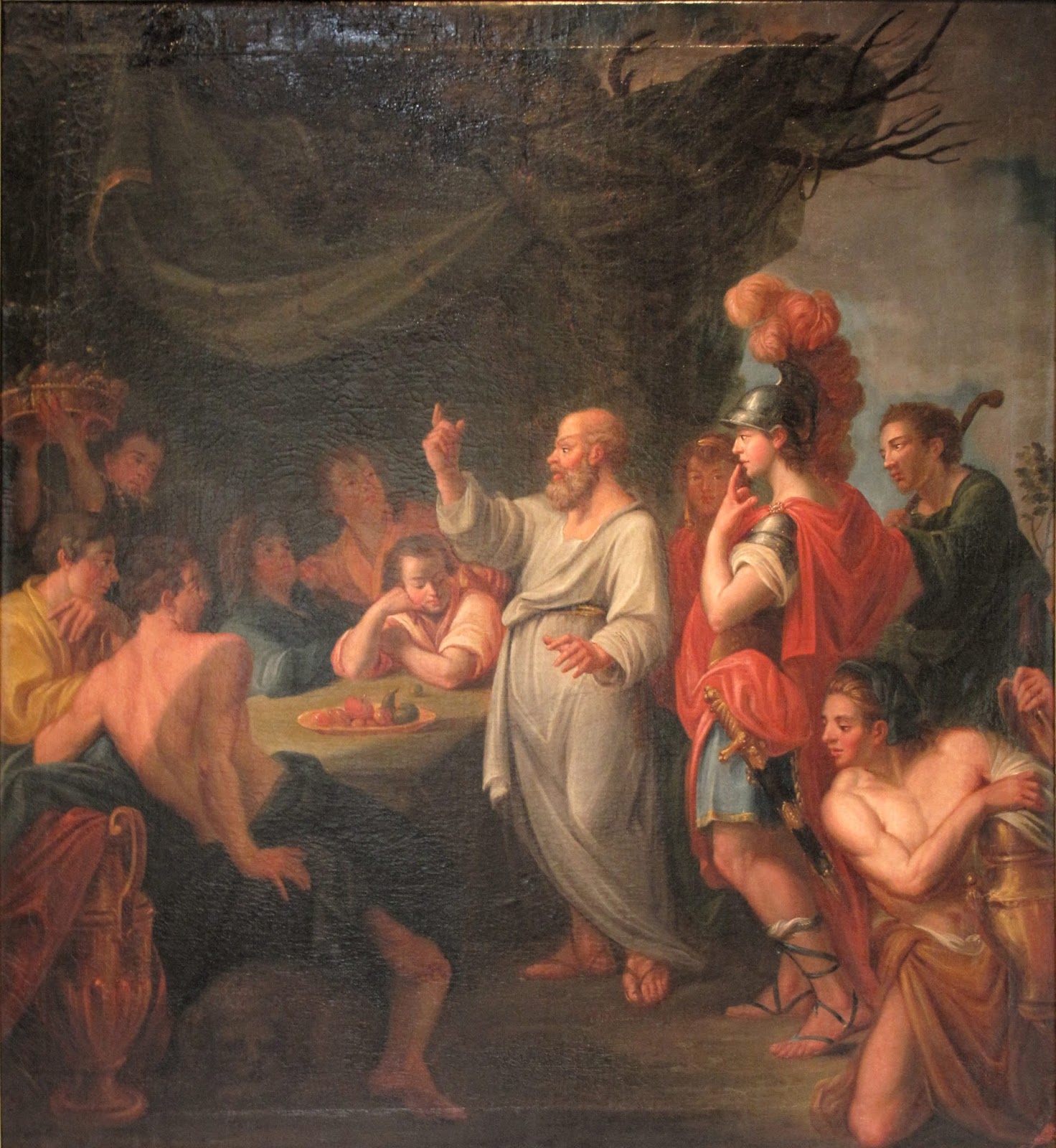
Socrates Teaching Perikles by Nicolas Guibal (1780)
What’s the first image that pops into your mind when someone mentions “the saints?”
Perhaps you think of the Twelve Apostles traveling the back roads of first century Judea with Our Lord. Or do you conjure up images of the early martyrs being eaten by lions for refusing to offer a pinch of incense before a statue of Caesar? Or perhaps you think of the Church Fathers like St. Augustine of Hippo or St. Athanasius standing firm for orthodoxy even as the world around them seems bent on embracing error and heresy. Or do the great Medieval theologians, like Thomas Aquinas or Francis of Assisi shaping Christendom with their intellect and love for poverty come first to mind?
All these, of course, are great examples of the holiness God calls all men to, but what about a saint who lived and breathed in our own twenty-first century?
That might be just what we witnessed in the life of the young Italian woman Chiara Corbella Petrillo, whose brief life has been an inspiration to many, especially as told by her close friends in Chiara Corbella Petrillo.
Chiara’s heart wrenching story, taking us through her marriage to Enrico (who authors a moving preface to the book), through her pregnancies which saw her children born with life threatening defects to such a degree that abortion was seen as the normal course of action to be taken. Chiara, however, strengthen by her Catholic Faith, embraced these troubles - risking even her own life when she decided to delay chemotherapy when she learned that she had cancer during her second pregnancy - and found at the bottom of them all - joy.
Her story is stunning. The amount of physical and emotional pain Chiara suffered in her brief 28 years is more than most will be forced to deal with in a lifetime and yet her experience of these sorrows is best summed up by her response to her husband’s question as to whether the yoke of Christ is sweet after all, “Yes, Enrico, it is very sweet.” Thus answers a saint.
If you need a good Christmas read to motivate you to take stock of your own relationship with Christ, especially in the rough patches we all face in this vale of tears, you ought to check out this inspiring story.
When was the last time you heard a homily on the Seven Deadly Sins?
Let me guess.
Never.
From the amount of attention this topic gets from the pulpit, you’d be forgiven for thinking the Seven Deadly Sins are:
no longer important
no longer a part of Church teaching
not all that deadly after all
And you’d be dead wrong.
Dr. Kevin Vost, author of Memorize the Faith!, in his latest book, The Seven Deadly Sins, has brought the “Capital Sins” right back to where they ought to be - the center of our attention.
Vost first takes his readers on a whirlwind tour of the history behind the Seven Deadly Sins. Starting in the dry deserts of the East, with men like Evagrius Ponticus and St. John Climacus and traveling to the West with more famous saints like John Cassian, Gregory the Great, and Thomas Aquinas, Vost succinctly and entertainingly lays out the “family history” of this most famous list of sins.
In the process, Vost destroys the oft heard myth that the Seven Deadly Sins “aren’t in the Bible” by showing where each of them is condemned in Scripture. He then traces the origins of the List from “Eight Evil Thoughts” to the “Seven Deadly Sins” and St. Thomas’ “Seven Capital Vices.”
As entertaining and interesting as the first section is, it proves to be no more than an extended introduction to the heart of the book - Vost’s “Battle Plans to Decimate Deadly Vice and Sin.” Our author goes through each of the Seven Deadly Sins, following St. Thomas Aquinas’ treatment of them in the Summa Theologiae, providing tips for overcoming each vice as a means of growing in holiness. Vost doesn’t stop with drawing on the writings of the Common Doctor, however. He also provides the latest in psychology and a reflection drawn from the Venerable Fulton Sheen linking each of the Seven Deadly Sins to one of the last Seven Words of Christ.
Let’s take an overview of Vost’s chapter on “Routing Wrath” as an example of his approach to each sin.
The Death-Dealing Daughters of Wrath
Vost is a great student of St. Thomas Aquinas (as demonstrated in his One Minute Aquinas), thus when he looks at each Capital Sin in turn he also looks at the “daughters” that St. Thomas associated with that sin. In all St. Thomas gives us forty-four sins that follow in the wake of the Seven Deadly Sins. Vost provides his readers with a list of questions that help identify these nefarious daughters in the life of each of us. For Wrath we’re asked to reflect on:
Whether we’ve allowed ourselves to become irritable and easily upset.
Whether we’ve dropped into sullenness, nursing old wounds, awaiting an opportunity to seek vengeance.
Whether we’ve developed a general attitude of ill-temper.
Whether we’ve belittled others with our thoughts or words, including insults, vulgarity, and even blasphemy.
Whether we’ve been driven to act out in violence by losing our temper.
Psychology
Being a psychologist, Vost doesn’t end with St. Thomas’ advice from seven centuries ago, but also incorporates helpful tips from modern psychology. For wrath, Vost looks at, and expands upon, the “ABC” approach. Every outburst of wrath is proceeded by an Activating Event, Vost gives the example of a large man stepping on your toe. This event is then interpreted by our Beliefs, here that the man is an inconsiderate jerk. The event plus the belief leads to unjust anger as a Consequence. Most of us stop there, immersed in the deadly sin of wrath and about to act out on her daughters. We can, however, short-circuit this process. Instead of flaring up, we ought to continue on with Disputing our beliefs. Perhaps we see that the man was blind or, failing something as easy as that, we remind ourselves of the suffering of Christ on the Cross - endured without wrath. This leads to a changed Consequence. If the man was blind we find ourselves no longer getting angry, but instead forgiving him and perhaps even admiring his courage for going about alone. If the man was just rude, we might pray for his conversion and offer our suffering for the sanctification of the Church. Either way we’ve avoided wrath and embraced a virtue instead.
The Last Words of Christ
Fulton Sheen used Christ’s prayer, “Father forgive them, for they know not what they do,” to defeat sinful anger. By reflecting on these words daily, perhaps first thing in the morning, we can develop a predisposition toward forgiveness and patience which will root out the tendency toward sinful wrath.
Vost takes each sin in turn, providing the same practical advice and guidance for each. He also encourages his readers to go to confession and to receive the Holy Eucharist in a state of grace as the best means of defeating sin. His words on lust might just as well apply to all Seven Deadly Sins,
We will have no chance of winning this battle if we plan to rely on our own strength. Rather, the first step we must take and never step away from is to admit that we cannot do it alone and to ask God to strengthen us with supernatural, spiritual weaponry. (p. 161).
Whether you struggle with one of the Seven Deadly Sins or, more likely, all of them, Vost’s latest book is certainly worth reading. As the culture we live in celebrates these sins more and more and denounces their opposing virtues more virulently Vost’s reminder that sin can be deadly and his advice, drawn from science, Scripture, and the saints, couldn’t be more timely. The number of souls claimed by Hell through the workings of the Seven Deadly Sins is a fearsome thought. Vost’s book can help you ensure you won’t be among them.
To purchase the book, and support this blog at no additional cost, follow THIS LINK to Amazon.
Say the word "evangelize" to many Catholics and the first thing that will spring to their is "oh, yeah, that's that thing Protestants do, right?" Wrong. Catholic popes have been imploring the faithful to go forth and evangelize for decades and the need to evangelize has become a major focus for the Church since the Second Vatican Council. Avery Cardinal Dulles makes this point better than I can,
Vatican I, which met from 1869-1870, used the term gospel (evangelium) only once and never used the terms evangelize and evangelization. Less than a century later, Vatican II mentioned the gospel 157 times and used the verb evangelize eighteen times and the noun evangelization thirty-one times.1
As important as evangelization, and indeed the "New Evangelization," are to the Church, many (dare I say most) cradle Catholics shy away from the terms as something uncomfortable, something foreign, something Protestant. The Holy Spirit, desirous that the repeated admonitions of the Holy Fathers be heard and acted on, has thus brought to bear a "secret weapon" for the Church - converts from Protestantism. It is, in many cases, these ex-Protestants (e.g. Dr. Scott Hahn, Dr. Peter Kreeft, Dr. Taylor Marshall, Steve Ray, Tim Staples, Jimmy Akin, Brandon Vogt, and many others) who are ready, willing, and able to go forth and evangelize.2 It is from this rich background, from a tradition that has long emphasized and embraced evangelization (or "evangelism" as many Protestants seem to prefer), that Shaun McAfee comes and he comes ready to share the fruits, the "inside information," of the Protestant world. It is just this that he does in Filling Our Father's House. What Converts Can teach Us about Evangelization, a book I was happy to receive a review copy of in the mail from Sophia Press.
In this great new manual for evangelization, McAfee takes Catholics through the foreign lands of Evangelical Protestant culture mining that culture for the valuable lessons we Catholics can learn about Evangelization from those more accustomed to it than we sometimes are. In this book we become familiar with: how to develop and deliver our "personal testimony," how to read the Bible regularly, how to deepen our "personal relationship" with Jesus, how to develop and lead "small groups," and how to take a more active role in the life of the parish (yes, there's more to it than just showing up on Sunday!)
Each section is well worth the price of the book (especially at only $10.83 for the paperback on Amazon.) I found the chapter on developing and giving a "personal testimony" to be particularly challenging. As readers may have noticed, I tend to write quite a bit about theology, philosophy, apologetics, news, etc, but not overly much about myself. I suppose I'm more Aquinas than Augustine in my writing in that regard. McAfee makes a great case for the power of the story of our conversion to a deeper love for Jesus and the Church. People love stories and would often rather listen to how we came to love Christ and the Church than to hear an argument for the existence of God (although there is a time and place for that important work, too). McAfee gives us the "how" in response to Pope Paul VI's "why,"
Modern man listens more willingly to witnesses than to teachers, and if he does listen to teachers, it is because they are witnesses.3
For example, McAfee recommends having several different "versions" of different lengths ready to go for any opportunity that comes to share yourstory.
My wife, who has been contemplating starting a "small group" at our parish (she is also a convert from Protestantism where such groups are common) will find the chapter dedicated to that topic invaluable as McAfee again gives not just the "why," but the "how" for starting such groups.
Overall, I highly recommend this book to anyone who is struggling with jumping into the New Evangelization. As evangelizing has become the primary mission of the Church even in historically Christian lands (which are rapidly becoming "mission territories"), I could even see parishes handing out copies of Filling Our Father's House to "jump-start" the evangelical fervor of their people. If we are to experience the much talked about "new springtime of the Church" in our Western world, indeed if we are to even survive as a Christian culture in the West, we need to first "go forth and make disciples" (Matt 28:19) and McAfee's book is a great way to get started doing just that.
_______________________
1. Avery Dulles “John Paul II and the New Evangelization: What does it Mean?” in ed. Ralph Martin and Peter
Williamson, John Paul II and the New Evangelization (Cincinnati: Servant/St. Anthony, 2006), 4.
2. Not that only Protestant converts to Catholicism are, or ought to be, the only ones doing this. I myself am a baptized Catholic and try my best here online and in life to evangelize as do many other "cradle Catholics." One needs only think of men like Father Barron, Patrick Coffin, Patrick Madrid, Popes Francis, Benedict, and John Paul, Mother Teresa, and many others here. 3. Evangelii Nuntiandi, 41



 .
.
 to Amazon.
 , a book I was happy to receive a review copy of in the mail from