Monday, August 22, 2016

The World of Ben Hur by Mike Aquilina

Mike Aquilina, whose books have been recommended on this blog a few times:

A.D. The Bible Continues: Ministers & Martyrs


A.D. the Bible Continues: The Catholic Viewers Guide


The Mass of the Early Christians


The Mass: The Glory, The Mystery, The Tradition


Has come out this a new book, this one on Ben Hur:


By now it is apparent that I enjoy Aquilina's books so I thought I might post an excerpt for my readers to see if they might be interested in this book. I haven't had the chance to read the whole thing, so I can't recommended it directly. However, if the excerpt and topic interest you, I can whole-heartedly recommend the author. It will especially interest those who have seen the 2016 motion picture:
One of the big attractions of Ben-Hur is that it gives us a chance to see Jesus Christ the way other people might have seen him in his own time. In our imagination, we strip away the centuries of accumulated tradition and look at Jesus with fresh eyes. Who was this carpenter from Nazareth? Just describing him that way makes him sound so insignificant: “Can anything good come out of Nazareth?” as Nathanael asked (John 1:46), probably repeating the punch line of a popular joke. How could an ordinary craftsman from the backwoods hill country change the whole world so completely?In Ben-Hur, we share the baffling, exciting, confusing, upsetting, and life-changing experience of discovering Jesus of Nazareth for the first time. We may be surprised to find him looking so ordinary. But that’s what the Gospels tell us: people who had known Jesus all his life thought of him as just an ordinary workman. When he went back to Nazareth, he could hardly find anyone to listen to him.And on the sabbath he began to teach in the synagogue; and many who heard him were astonished, saying, “Where did this man get all this? What is the wisdom given to him? What mighty works are wrought by his hands! Is not this the carpenter, the son of Mary and brother of James and Joses and Judas and Simon, and are not his sisters here with us?” And they took offense at him.And Jesus said to them, “A prophet is not without honor, except in his own country, and among his own kin, and in his own house.” (Mark 6:2-4) The people around Nazareth had a hard time thinking about Jesus as a teacher or a prophet. They knew him too well. They knew his mother and his cousins. His whole extended family was a familiar sight. To the people of his hometown, Jesus was always a carpenter, the son of a carpenter, a man who worked with saws and planes.We have some of the same problem, except in reverse. We’ve always known Jesus as the Christ, the Son of God. We can’t see him as an ordinary craftsman who made things with his hands and sold them to customers. Yes, we know intellectually that he did that — otherwise the Nazareth passage in Matthew and Mark doesn’t make sense. But we can’t imagine him doing it.Ben-Hur helps us imagine Jesus the man, the strangely ordinary carpenter who did and said such extraordinary things. Whenever a prophet who spoke with great confidence and wisdom came around, the people of Judea always began to ask themselves the same thing: Is this the Messiah? Is this the Christ? Is this the Anointed One of God?When John the Baptist started preaching in the wilderness and attracting big crowds, the question naturally came up.And this is the testimony of John, when the Jews sent priests and Levites from Jerusalem to ask him, “Who are you?” He confessed, he did not deny, but confessed, “I am not the Christ.” (John 1:19-20)They believed that the Messiah would liberate them from the power of the Romans and establish the kingdom of Israel as a great power. Naturally, the Romans were always just a little worried about potential messiahs. So were the Sadducees, the upper classes who had much to lose and nothing to gain from a break with Rome.That explains some of Jesus’ behavior in the earlier part of his ministry.“Who do men say that I am?”And they told him, “John the Baptist; and others say, Elijah; and others one of the prophets.”And he asked them, “But who do you say that I am?” Peter answered him, “You are the Christ.”And he charged them to tell no one about him. (Mark 8:27-30)That last line — repeated many times in the Gospel of Mark — always baffles us. Isn’t the whole point that everyone should know the Messiah has come? But Jesus knew what he was doing. If people thought he was claiming to be the Messiah at the beginning of his ministry, there would never be a rest of his ministry.Throughout the relatively short time he spent preaching in Galilee and Judea, Jesus refused to meet people’s expectations of what the Messiah would do. The rich and the ostentatiously virtuous sneered, “This man receives sinners and eats with them!” (Luke 15:2). It was the poor and lowly who seriously asked, “Can this be the Christ?” (John 4:29).The movie Ben-Hur gives us a good picture of those reactions. Judah, from a rich family, is dubious about the carpenter with all his strange talk about loving one’s enemies. It’s the poor who are enthralled by him. Only when Judah has lost everything does he have a chance to see Jesus of Nazareth for who he really is.Even Jesus’ closest disciples didn’t understand the nature of his kingdom.
If that sounds like something you'd be interested in reading, click here: http://amzn.to/2bA3Xt5 to purchase on Amazon.com and, at no additional cost to you, support AdoroErgoSum.


Like what you've read? Subscribe to my mailing list. NO SPAM, ever. Emails go out no more than once a week.
* indicates required

Tuesday, August 16, 2016

12 Reasons to Stop What You Are Doing and Pick up Dante

As long time readers know, my blogging has been less than regular over the last year (all the more reason to sign up for my email list) due to the class I've been developing and teaching on Dante Alighieri's Divine Comedy. The class aims at bringing Catholics closer to their Faith and to Jesus through reading the greatest poem in Christendom.

If you haven't had the chance to read Dante recently and need a little extra motivation, here are 12 reasons to immediately put on hold whatever you are currently reading and pick up a copy of La Commedia. Feel free to share these far and wide!


Many of you might remember the series of posts I did awhile back entitled "Blogging through Hell" which brought us most of the way through the Inferno. I point you back to those if you haven't read them, but with the caution to not make a common "rookie mistake" when approaching the Poem; don't stop with Inferno. Dante's journey through the afterlife isn't one of Hellish gloom ending in a vision of Satan chewing on sinners. Rather, The Comedy is the story of freedom from sin to behold the very Face of God. IOW, finish the whole poem!


If you don't have a copy of Dante's Comedy at hand I suggest Mark Musa's translation as the best for a beginner. He has a three volume set (with many helpful notes) and a one volume stand alone, titled The Portable Dante, (which has less, but still a good number of notes and contains Dante's second most famous work the Vita Nuova in addition to the entire Comedy.) 


Subscribe to the AdoroErgoSum mailing list (no spam - ever)

* indicates required

Saturday, August 6, 2016

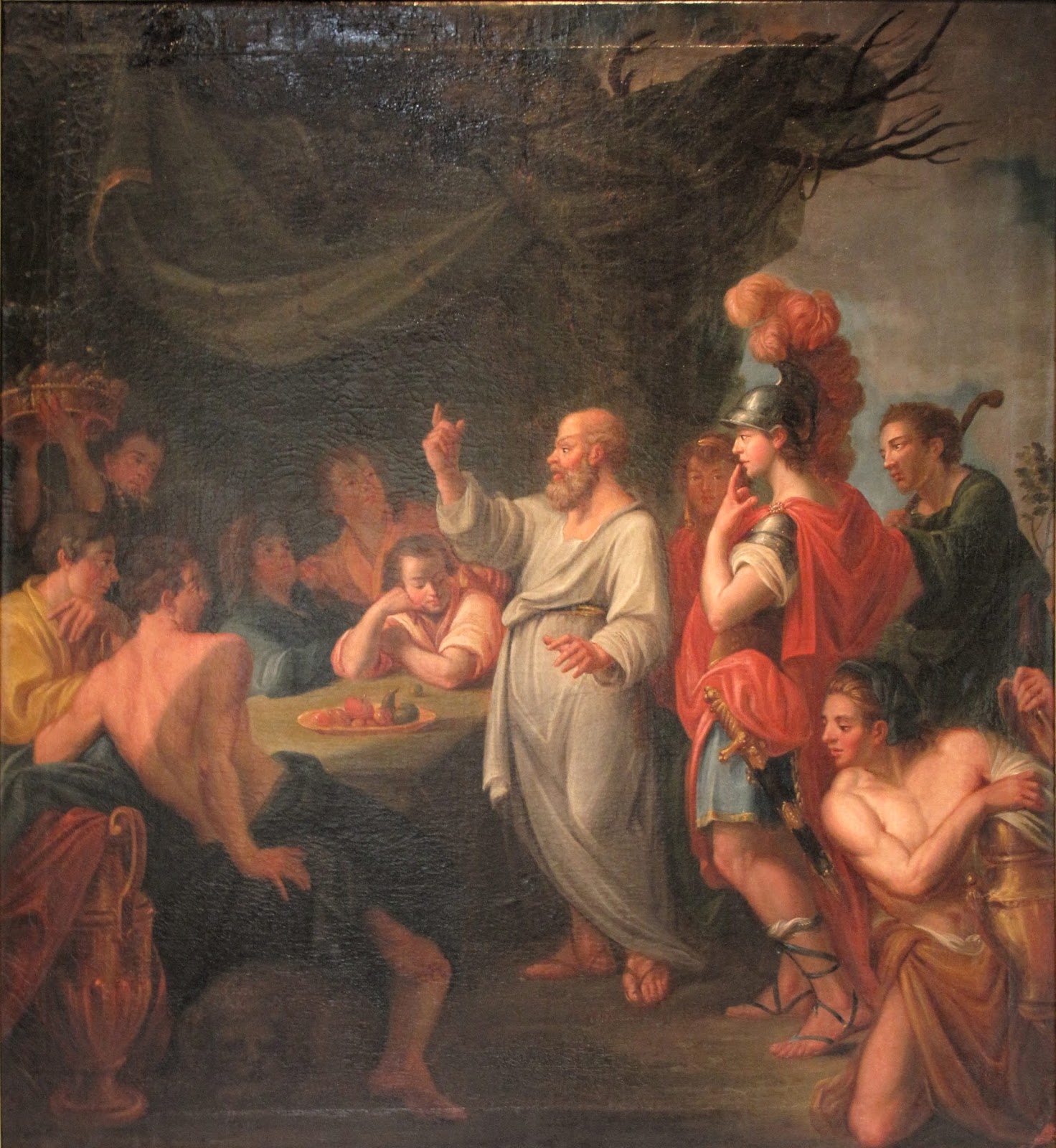
Comment Policy from Socrates

Here at Adoro Ergo Sum, I have a simple policy regarding comments and debate on the issues presented for your reading pleasure. It's been awhile since I've been able to post regularly thanks to a class I've developed and which I've been engaged in teaching over the last year on the Divine Comedy of Dante Alighieri - the greatest poem in the history of mankind - which ought to be read a couple times by every learned person.

As I hope to be able to post on a more regular basis coming up, I thought a brief reminder on the comment policy might be in order:
I am one of those people who are glad to have their own mistakes pointed out and glad to point out the mistakes of others, but who would just as soon have the first experience as the second; in fact I consider the first a greater gain, inasmuch as it is better to be relieved of very bad trouble oneself than to relieve another, and in my opinion no worse trouble can befall a man that to have a false belief about the subjects which we are now discussing. So, if you are of the same mind let us go on with the conversations but if you think that we ought to abandon it let us drop it at once and bring the argument to an end. - Socrates, in Plato's Gorgias
Here's to helping one another overcome error!

Socrates Teaching Perikles by Nicolas Guibal (1780)

Subscribe to our mailing list (no spam - EVER!)

* indicates required

Monday, April 11, 2016

11 Favorite Pope Benedict XVI Memes

Long time readers know of my esteem for out Pope Emeritus, Benedict XVI (or "Father Benedict" as he now prefers to be called). His clear thinking and powerful writing played an important role in my conversion. I've previously linked to some of my personal favorite Pope Benedict books (HERE) and thought I'd share some of my favorite Pope Benedict memes, which provide a sample of his formidable thought. Please feel free to share these as you will...


Subscribe to my mailing list

* indicates required

Friday, March 18, 2016

3 Holy Week Meditations with the Painter Giotto


Giotto di Bondone was one of the most important painters in history. He was at the forefront of what would be called the Renaissance in painting, bringing a far greater degree of realism to religious art. This realism allowed people to "see" the events of Christ's life in a whole new way, a way which imprinted the reality of these events to a greater degree than before possible. You can think of these paintings as to the Thirteenth Century what The Passion of the Christ is to us today - a jolting visual reminder of the events that opened the doors for our salvation. In fact, Giotto's masterpieces maintain their power to inspire meditation even for us today.

What better way, then, to enter into Holy Week than to take some time, reflect on the Biblical Word and enter into these events with the great Giotto?

Feel free to share these images on social media.

1. Betrayal


2. Crucifixion


3. Lamentation


A Couple Favorite Giotto Stories


(W)hen Giotto was still a young man with Cimabue (his teacher), he once painted upon the nose of a figure that Cimabue had completed a fly which looked so natural that when his master returned to continue the work, he tried more than once to drive the fly away with his hand, convinced that it was real. (p. 35)
As Giotto's fame grew he received commissions from great patrons, including Pope Benedict IX, who was looking to have several paintings done for St. Peter's. When the Pope's courtiers traveled to Florence to get a sample from Giotto of his work...
Giotto... took a sheet of paper and a brush dipped in red, pressed his arm to his side to make a compass of it, and with a turn of his hand made a circle so even in shape and outline that it was a marvel to behold. (p. 22)
Not only did this get Giotto the job, it also gave rise to a proverb in Tuscany that was still current two centuries later when Vasari was writing,
'You are rounder than Giotto's O.' This proverb may be considered delightful, not only for the incident which gave rise to it but even more so because of its meaning, which involves the ambiguity the word 'tondo' takes on it Tuscany, where it refers not only to a perfect circular figure but also to dullness and crudeness of wit. (p. 23)
And to showcase Giotto's legendary wit, let this story from his time in the Kingdom of Naples suffice,
On another occasion, the king said to him: 'Giotto, now that it is so hot, I would put aside my painting for a while if I were you.' And Giotto answered, 'I certainly would too, if I were you.' (p. 27)
If all that isn't enough to make you love Giotto, he was also responsible for this, the campanile (bell tower) of Florence's Cathedral, which I've had the immense pleasure of climbing...


Have a blessed Holy Week and remember to always keep this in mind...


------------------------
Recommended Reading:


If you enjoyed this post, check out my other posts on Catholic Art


And don't forget to sign up to my mailing list to make sure you never miss a post (I typically mail out less than once a week and you'll get NO spam, ever)


Subscribe to my mailing list

* indicates required

Monday, February 29, 2016

Do Catholics Worship Statues? 5 Step Refutation

Catholics worship statues. 
Raise your hand if you’ve encountered that statement. 
That’s a lot of hands. 
I’ve ran into this “argument” against Catholicism quite a few times over the years (one of the side-effects of being a Catholic blogger, I suppose) and, wouldn’t you know it, I met it again yesterday.
What brought it on this time? A simple posting of a detail from Raphael’s Transfiguration, showing Christ rising in dazzling white robes into the air from the top of Mount Tabor with the words “This is my Son; listen to Him” from Luke 9:35, words which were ringing in my ears from that week’s Gospel reading. 
1. The Charge: You Catholics Clearly Break God’s Law

While most people enjoyed the meme, one fellow disapprovingly left “Ex. 20:4” in comments....


Enjoy this post? Subscribe to my mailing list

* indicates required

Tuesday, February 9, 2016

Encountering Jesus in Beauty. A Reflection on the Sistine Chapel.

We've discussed the argument for the existence of God from beauty a couple times here on the blog:


It should, then, come as little surprise to long time readers that my own conversion to Catholicism was influenced by beauty. Truth may have been the primary factor in my conversion, but the other two transcendentals (beauty and goodness) each had their own, significant, role to play.

I go into a bit of detail on how beauty shaped my journey towards truth over at Catholic365, in my latest:

Michelangelo and Metanoia. A Personal Reflection on the Sistine Chapel.

That's an odd moment when I'm feeling more like St. Augustine than St. Thomas Aquinas at my desk, but Rome (and beauty) can do that to a blogger!

Here I'd like to elaborate a bit more on why I think my experience in the Sistine Chapel, my experience with beauty, was so profound.


If I had to sum it up in a single word it would be "encounter."

Reading the Scriptures, one can't help but notice the power of the first encounter with Christ. When St. Peter first meets Jesus he receives the command, "put out into the deep (Lk 5:4)." Peter cooperates and is forever altered. The disciples on the road to Emmaus, depressed over the death of Jesus, encounter the Risen One and cry out to one another "where not our hearts burning within us (Lk 24:32)." Saul, on the road to Damascus, meets Jesus and goes from being the most fervent anti-Christian persecutor to become the Apostle to the Gentiles. Encounter. Transformation. It is always the same story. Archbishop Fulton Sheen once noted, when reflecting on the Christmas narrative, that of course the Wise Men returned home "by another way (Matt 2:12)" for "no one who ever meets Christ with a good will returns the same way as he came. (Magi and the Slaughter of the Innocents)"

That encounter is what our great Catholic Faith is all about. It isn't about rules. It is about a relationship - a relationship with the God who becomes a man so that we might encounter Him. So that we, so that you and I, might meet Him. That is what everything in our Holy Catholic Faith is all about. Nothing in our religion, the prescriptions, the rituals, the morality - none of it makes sense apart from meeting the man Christ Jesus. That is why the original proclamation wasn't morality, wasn't even (despite what some liberal Christians might wish to think) "be kind" but rather was "He is Risen" (i.e. you can meet this man!).

Dr. Peter Kreeft has said he personally has known several people who were converted by beauty, who were converted by listening to Bach's St. Matthew Passion. Such beauty, they realized, simply wasn't compatible with a meaningless, atheistic, materialistic worldview. Dr. Kreeft, in his Letters to an Atheist explains that these moments are
"signals of transcendence," fingers pointing beyond themselves towards exits from the cave (i.e. this world).... It's not just sentimentalism; it's an intellectual intuition: the music we have in our soul just has to match the music outside our soul. There has to be more. Not that it's not a great cave. But there has to be more. We see this with most conviction not when we are poor and in pain, when the cave is the smallest and darkest and most uncomfortable. It's precisely at those moments when we feel the cave's greatness the most, when we are most open to the charms and beauties of our physical and emotional universe, that we feel this "divine discontent," this "lover's  quarrel with the world."
My Sistine experience was quite a bit subtler. I wasn't converted (I'm too much a philosopher for that I suppose. I needed arguments to finish the job), but my soul had been enriched by Michelangelo's masterpiece. No longer was I one type or another of "bad soil" described by Christ in the Parable of the Sower (Matthew 13:1-23, Mark 4:1-20 and Luke 8:4-15). I would, slowly, be prepared to receive the Gospel years later by this first encounter.

C.S. Lewis, himself a covert to Christianity, in his book Miracles masterfully captures the feeling - and the resistance - to this encounter and why we often prefer something less "personal" than the "living God,"
"Men are reluctant to pass over from the notion of an abstract and negative deity to the living God. I do not wonder. Here lies the deepest taproot of Pantheism and of the objection to traditional imagery. It was hated not, at bottom, because it pictured Him as a man but because it pictured Him as a king, or even as a warrior. The Pantheist’s God does nothing, demands nothing. He is there if you wish for Him, like a book on a shelf. He will not pursue you. There is no danger that at anytime Heaven and Earth should flee away at His glance. If He were the truth, then we could really say that all the Christian images of kingship were a historical accident of which our religion ought to be purged. It is with a shock that we discover them to be indispensable. You have had a shock like that before, in connection with smaller matters – when the line pulls at your hand, when something breathes beside you in the darkness. So here; the shock comes at the precise moment when the thrill of life is communicated to us along the clue we have been following. It is always shocking to meet life where we thought we were alone. “Look out!” we cry, “it’s alive!” And therefore this is the very point at which so many draw back – I would have done so myself if I could – and proceed no further with Christianity. An “impersonal God” – well and good. A subjective God of beauty, truth and goodness, inside our own heads – better still. A formless life force surging through us, a vast power which we can tap – best of all. But God Himself, alive, pulling at the other end of the cord, perhaps approaching at an infinite speed, the hunter, king, husband – that is quite another matter. There comes a moment when the children who have been playing at burglars hush suddenly: was that a real footstep in the hall? There comes a moment when people who have been dabbling in religion (“Man’s search for God”!) suddenly draw back. Supposing we found Him? We never meant it to come to that! Worse still, supposing He had found us? So it is a sort of Rubicon. One goes across; or not. But if one does, there is no manner of security against miracles. One may be in for anything.
That is what happened to me in Rome, in the Sistine.

For more check out my latest at Catholic365: Michelangelo and Metanoia. A Personal Reflection on the Sistine Chapel. 

And, if you want to learn more about the Pope's Chapel, I suggest you take a few moments to watch a fantastic TED talk which has been making the rounds on the Catholic blogosphere:


If you really enjoyed Ms. Lev's talk, you can head to Rome with Catholic apologist Steve Ray and have a tour of the Sistine from Ms. Lev.

You will go with my seething envy, but don't let that stop you! Mr. Ray is a top-notch apologist and, from what I've read, an excellent pilgrimage guide.

If you can, head to Roma. Allow yourself, like the pilgrims of old, to deepen your love for the One, Holy Faith at tombs of Peter and Paul and in the Sistine. You won't regret it.

Pax et bonum.

--------------------------

Recommended Reading (purchase through the links provided to support this blog at no cost to yourself):


Enjoy this post? Subscribe to my mailing list! (No spam, ever. Emails sent once every 1-2 weeks).

* indicates required